Wednesday, May 20, 2015

Large Water-Rich Moons around Super-Jovian Planets

Large moons similar in size to the planet Mars (0.53 Earth radii) or Jupiter’s moon Ganymede (0.41 Earth radii) should be detectable in the available dataset of photometric measurements by NASA’s Kepler space telescope. Super-Jovian planets (i.e. planets more massive than Jupiter) appear to be abundant at ~1 AU around Sun-like stars (i.e. 1 AU is the distance of Earth from the Sun). At these distances, temperatures are just right for large moons around these planets to potentially support life. As a result, it is worth considering whether super-Jovian planets at ~1 AU around Sun-like stars can host large moons that are habitable.

Figure 1: Artist’s impression of a gas giant planet like Jupiter with a system of moons orbiting it.

A study by Heller & Pudritz (2015) predicts that water-rich Mars-mass moons can form around super-Jovian planets that lie beyond ~5 AU around Sun-like stars. Jupiter-mass planets that form closer than ~4.5 AU to Sun-like stars are unlikely to form water-rich moons because their accretion disks are less massive and depleted of water-ice. However, a super-Jovian planet with 12 times the mass of Jupiter can potentially form water-rich moons as close as ~3 AU to a Sun-like star as its accretion disk is significantly more massive.

A super-Jovian planet with 10 times the mass of Jupiter forming at 5.2 AU around a Sun-like star can form a moon system with a total mass of roughly 10 times the mass of Ganymede or 2 times the mass of Mars. Simulations indicate that this mass is distributed over 3 to 6 moons in ~90 percent of the cases. If the same planet formed at 9.6 AU, the distance of Saturn from the Sun, the total mass of its moon system can be twice as large.

Figure 2: Artist’s impression of a gas giant planet seen partly through the atmosphere of a large moon in orbit around it.

Figure 3: Artist’s impression of a large, potentially habitable moon in orbit around a gas giant planet.

Due to various interactions, planets like Jupiter tend to migrate away from where they initially form. It is more plausible that observed population of super-Jovian planets at ~1 AU around Sun-like stars formed further out and migrated inwards to their current positions. If these super-Jovian planets formed beyond about 3 to 4.5 AU, they should host water-rich Mars-sized moons. At ~1 AU from a Sun-like star, such a moon can be a potentially habitable ocean world. The abundance of super-Jovian planets at ~1 AU around Sun-like stars could mean that Mars-mass ocean worlds are a common type of habitable environment in the universe.

A super-Jovian planet hosting two or more habitable moons can have interesting astrobiological implications because life on these moons can share a common evolutionary tree of life. This is because a system of moons around a super-Jovian planet is much more compact than a system of planets around a star. As a consequence, it is much easier for the process of panspermia to transfer biological material from one habitable moon to another.

In the less plausible scenario that super-Jovian planets at ~1 AU around Sun-like stars formed in-situ, then they are less likely to host water-rich moons. The absence or presence of water-rich Mars-sized moons orbiting super-Jovian planets at ~1 AU around Sun-like stars can indicate whether these planets tend to form in-situ or tend to migrated to their current positions from further out.

Reference:
Heller & Pudritz (2015), “Conditions for water ice lines and Mars-mass exomoons around accreting super-Jovian planets at 1 - 20 AU from Sun-like stars”, arXiv:1504.01668 [astro-ph.EP]

Tuesday, May 19, 2015

Cloudy Mornings & Searing Afternoons on Hot-Jupiters

Hot-Jupiters are a class of planets that orbit very close to their host stars. As a result, these planets receive extremely intense irradiation and are expected to be tidally-locked, with one side experiencing permanent day and one side experiencing permanent night. The strong temperature contrast between the permanent day and night sides on a hot-Jupiter drives a powerful west-to-east circulation that goes around the planet.

If the orbit of the hot-Jupiter is observed edge-on, it will appear to pass behind its host star on every orbit. Such an event is known as an eclipse. The planet’s evening-side is more visible pre-eclipse (i.e. during the first half of the orbit), while the planet’s morning-side is more visible post-eclipse (i.e. during the second half of the orbit). As the planet circles around its host star, some fraction of its illuminated hemisphere will be visible depending on the position of the planet in its orbit. This generates a light curve where the combined brightness of the star and planet varies in a small and periodic fashion every orbit. The variation is small because the star is orders of magnitude brighter than the planet.

Figure 1: Artist’s impression of a hot-Jupiter that is glowing red hot.

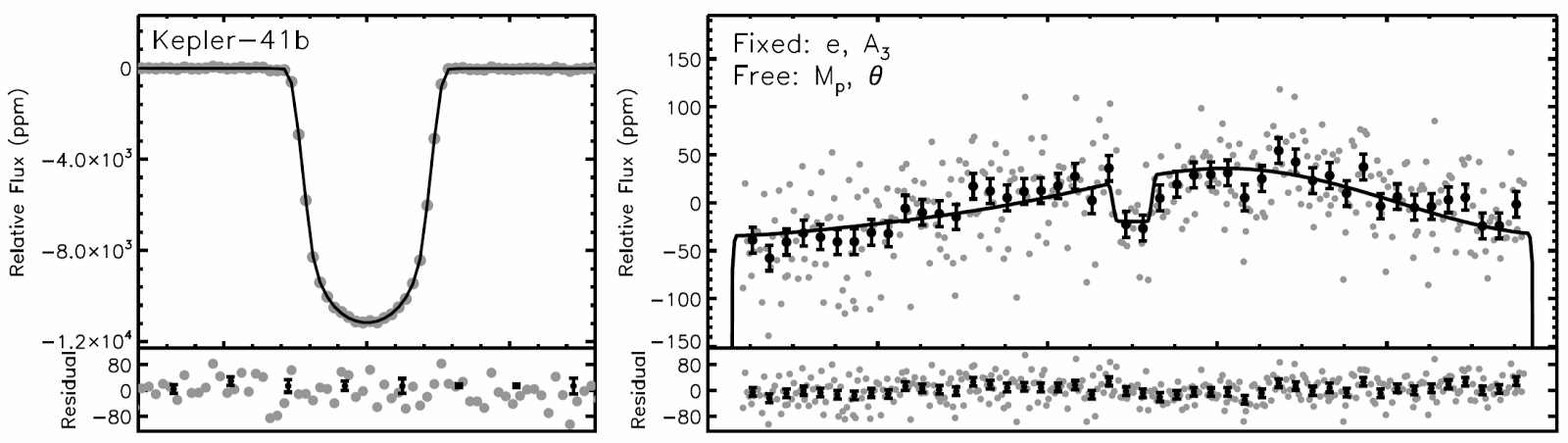
Using data from NASA’s Kepler space telescope, a study by Esteves et al. (2015) uncovered weather cycles on 6 hot-Jupiters. The brightest spot on each planet appears offset from the substellar point. Basically, the substellar point on a hot-Jupiter is the spot on the planet where the planet’s host star is directly overhead and it is where the stellar irradiation is most intense. The 2 hotter planets (Kepler-76b and HAT-P-7b) appear brightest pre-eclipse (i.e. the brightest spot on the planet is east of the substellar point, towards the evening-side); while the 4 cooler planets (Kepler-7b, Kepler-8b, Kepler-12b and Kepler-41b) appear brightest post-eclipse (i.e. the brightest spot on the planet is west of the substellar point, towards the morning-side).

On these 6 hot-Jupiters, winds blow eastward from the substellar point towards the evening-side, around the night side and back towards the morning-side, before returning to the substellar point. The 4 cooler planets (Kepler-7b, Kepler-8b, Kepler-12b and Kepler-41b) all have temperatures under ~2,300 K. The best explanation why they appear brightest on the morning-side (i.e. post-eclipse) is because cool temperatures on the night side allow clouds to form by condensation and the west-to-east atmospheric circulation brings these reflective clouds to the morning-side, causing the morning-side to be the brightest region on the planet. Subsequently, these clouds continue on towards the substellar point where they dissipate due to the increased irradiation.

In contrasts, the 2 hotter planets (Kepler-76b and HAT-P-7b) have temperatures exceeding ~2,700 K and both planets appear brightest on the evening-side (i.e. pre-eclipse). The best explanation is that the brightness is dominated by thermal emission from a hot-spot that has been shifted east from the substellar point, towards the evening-side. Furthermore, the high temperatures make it difficult for clouds to form, resulting in little or no clouds on the morning-side that can reflect a sufficient amount of incoming stellar radiation to contribute significantly to the planet’s brightness.

For the 4 cooler planets, the brightest spot is shifted west (i.e. towards the morning-side) from the substellar point by over ~25° since the clouds are probably thickest and most reflectively near the day-night terminator on the morning-side. For the 2 hotter planets, the brightest spot is shifted by a much smaller amount of less than ~8°, this time the shift is eastwards (i.e. towards the evening-side). The brightest spot is closer to the substellar point for the 2 hotter planets due to the rapid re-emission of absorbed stellar energy after leaving the substellar point. This study supports the correlation between the position of a planet’s brightest spot and the planet’s temperature. The brightness of a hotter planet is likely to be dominated by thermal emission from a hot-spot that has been shifted east of the substellar point (i.e. evening-side), while the brightness of a cooler planet is likely to be dominated by reflected light from clouds west of the substellar point (i.e. morning-side).

Figure 2: Light curve of Kepler-8b, a hot-Jupiter with 1.42 times the radius and 0.59 times the mass of Jupiter, in a 3.52-day orbit around its host star. The left and right panels contain, respectively, the transit light curve (i.e. drop in the star’s brightness when the planet passes in front of its host star) and phase light curve (i.e. combined brightness of the star and planet as the planet orbits the star). On the right panel, the dip in the middle denotes the eclipse, whereby the planet passes behind its host star and is obscured. Esteves et al. (2015).

Figure 3: Light curve of Kepler-12b, a hot-Jupiter with 1.75 times the radius and 0.43 times the mass of Jupiter, in a 4.44-day orbit around its host star. Esteves et al. (2015).

Figure 4: Light curve of Kepler-41b, a hot-Jupiter with 1.04 times the radius and 0.56 times the mass of Jupiter, in a 1.86-day orbit around its host star. Esteves et al. (2015).

Figure 5: Light curve of Kepler-8b, a hot-Jupiter with 1.36 times the radius and 2.01 times the mass of Jupiter, in a 1.54-day orbit around its host star. Esteves et al. (2015).

Reference:
Esteves et al. (2015), “Changing Phases of Alien Worlds: Probing Atmospheres of Kepler Planets with High-Precision Photometry”, arXiv:1407.2245 [astro-ph.EP]

Monday, May 18, 2015

Tightly-Packed Multi-Planet Systems

Over the years, observations by NASA’s Kepler space telescope have shown that tightly-packed multi-planet systems are common around Sun-like stars. Each of these multi-planet systems contains 4 to 6 planets packed within a region of space much smaller than Mercury’s orbit around the Sun. In these tightly-packed multi-planet systems, the spacings between adjacent planets appear to cluster at ~12 mutual Hill radii. The Hill radius of a planet is the region of space around a planet where the planet’s gravity dominates. For a satellite to orbit the planet, it has to lie within the planet’s Hill radius. In these tightly-packed multi-planet systems, the planets tend to have almost circular orbits that lie on the same plane.

Figure 1: Artist’s impression of a multi-planet system seen from one of the planets.

Observations by Kepler have also turned up planetary systems that are sparsely populated, in particular, single or double planetary systems. These planets tend to have orbits that are more inclined and more eccentric. One hypothesis suggests that sparsely populated planetary systems could be the remnants of tightly-packed multi-planet systems that have undergone dynamic instability. Interactions during the period of dynamic instability can leave the remaining planets with more inclined and more eccentric orbits.

Simulations show that for a multi-planet system to remain stable for as long as a billion years, the required minimum spacing between adjacent planets is ~10 mutual Hill radii if all planets have orbits that are circular and lie on the same plane. However, if the orbits of the planets are slightly eccentric, then the required minimum spacing between adjacent planets is ~12 mutual Hill radii. The similarity between what is observed and what is theoretically predicted for tightly-packed multi-planet systems suggests that planetary systems tend to form with much tighter spacings between adjacent planets. Tightly-packed multi-planet systems with 5 or more planets are probably planetary systems that have remained stable since formation, while single or double planetary systems are the remnants of more tightly-packed multi-planet systems.

Figure 2: The observed K-distribution (i.e. distribution of the spacings between adjacent planets in units of mutual Hill radii) of multi-planet systems shown as solid histograms for the 4 planet and 5 planet + 6 planet systems. Pu & Wu (2015).

Reference:
Pu & Wu (2015), “Spacing of Kepler Planets: Sculpting by Dynamical Instability”, arXiv:1502.05449 [astro-ph.EP]

Sunday, May 17, 2015

A Way to Produce Neutron Star-Black Hole Binaries

Massive stars in binary systems can potentially evolve to form exotic compact binary objects such as neutron star-black hole (NS-BH) binaries or neutron star-neutron star (NS-NS) binaries. Consider a binary system with two massive stars closely orbiting one another. The more massive star evolves quicker and eventually runs out of nuclear fuel to support itself. Its core collapses to form a neutron star (NS) via a supernova explosion. Meanwhile, the less massive star continues to evolve and swells in size as it builds up a carbon-oxygen (CO) core in its center. The star’s outer layers eventually engulf the nearby NS and cause the NS to spiral inwards, towards the CO core.


As the NS spirals in, it transfers angular momentum to the star’s outer layers. This causes the star’s other layers, comprised mostly of hydrogen and helium, to be expelled into space, leaving behind a massive CO core. What was once a binary system consisting of two massive stars is now a tightly-bound binary system consisting of a massive CO core with ~2 times the Sun’s mass and a NS with more than ~2 times the Sun’s mass. Subsequently, the massive CO core also collapses in a supernova explosion, leaving behind a new neutron star (νNS) with ~1.5 times the Sun’s mass. The supernova explosion ejects ~0.5 Sun’s mass worth of material that was once part of the massive CO core.

The nearby NS grows in mass by accreting matter from the supernova ejecta. Soon, the NS becomes too massive and collapses gravitationally to form a black hole (BH) with at least ~2.5 times the Sun’s mass. An energetic gamma ray burst (GRB) is produced during the collapse. The tightly-bound νNS- BH binary system continues to evolve into an ever tighter configuration via the emission of gravitational waves. Such a νNS- BH binary system may be detectable from its gravitational wave signal. Within a span of 10,000 years or less, the νNS-BH binary eventually merge, driving an ultra-short duration GRB. Two supernovae (i.e. plural of supernova) and two GRBs later, a binary system of two massive stars is now a single black hole drifting through space.

Reference:
C. L. Fryer, F. G. Oliveira, J. A. Rueda, R. Ruffini (2015), “On the Neutron Star-Black Hole Binaries Produced by Binary-driven Hypernovae”, arXiv:1505.02809 [astro-ph.HE]

Saturday, May 16, 2015

Discovery of a Low-Mass Double-Lined Eclipsing Binary

Figure 1: Artist’s impression of a binary star system.

G. Zhou et al. (2015) present the discovery and characterisation of a binary system consisting of two low-mass red dwarf stars that periodically eclipse one another. The binary system is identified as HATS551-027. The more massive star is HATS551-027A and the less massive star is HATS551-027B, hereafter referred to as components A and B. HATS551-027 is also a double-lined binary system and this means that the spectral lines of both stars are visible. Double-lined eclipsing binary systems comprising of low-mass red dwarf stars serve as good natural laboratories for the precise measurements of fundamental stellar parameters (i.e. mass, radius, etc) of low-mass stars. These measurements can then be used to validate and improve models of low-mass stars.

The two components of HATS551-027 circle around one another ever ~4.1 days. Component A is estimated to have 0.24 times the mass and 0.26 times the radius of the Sun while component B is estimated to have 0.18 times the mass and 0.22 times the radius of the Sun. Compared to theoretical models, the radius of component A is consistent while the radius of component B is inflated by 9 percent at 2σ significance. Both components of HATS551-027 have masses low enough to support fully convective interiors. The estimated effective temperatures for components A and B are 3,190 ± 100 K and 2,990 ± 110 K, respectively. Both stars appear slightly cooler than predicted by theoretical models. HATS551-027 is the third well characterised double-lined eclipsing binary system with both components supporting fully convective interiors. The other two are CM Draconis and KOI-126.

Figure 2: Light curves of HATS551-027. The left panel corresponds to the primary eclipse (i.e. component B passing in front of component A) and the right panel corresponds to the secondary eclipse (i.e. component A passing in front of component B). G. Zhou et al. (2015).

Figure 3: Radial velocity curves of HATS551-027A (red) and B (black). As both components circle around one another, one component will appear to recede while the other component will appear to approach, and vice versa. The receding component will have its spectral lines red-shifted (i.e. positive radial velocity) while the approaching component will have its spectral lines blue-shifted (i.e. negative radial velocity). G. Zhou et al. (2015).

Figure 4: The measured masses, radii and temperatures of the well characterised double-line eclipsing binaries compared with theoretical models. G. Zhou et al. (2015).

Reference:
G. Zhou et al. (2015), “A 0.24+0.18 Msun double-lined eclipsing binary from the HATSouth survey”, arXiv:1505.02860 [astro-ph.SR]

Friday, May 15, 2015

Warm Neptunes with Helium Atmospheres

Warm Neptune-sized and sub-Neptune-sized exoplanets are a class of planets that orbit closer to their host stars than Mercury’s orbit around the Sun. Although these planets started out with hydrogen-helium atmospheres, the strong irradiation they receive due to their close proximity to their host stars can drive away the hydrogen and lead to the formation of helium-dominated atmospheres. If the planet started out with a hydrogen-helium atmosphere that is ~0.1 percent of the planet’s mass, the effect of intense stellar irradiation can drive off the hydrogen in the atmosphere in ~10 billion years. In a helium-dominated atmosphere, the scarcity of hydrogen causes the main molecular carrier of carbon to be carbon monoxide (CO) rather than methane (CH4).

GJ 436 b is a Neptune-sized planet with 23.2 times the mass and 4.22 times the diameter of Earth. It is in a close-in orbit around a red dwarf star and it may have a helium-dominated atmosphere. Observations of GJ 436 b indicate that the planet’s atmosphere is rich in carbon monoxide (CO) but depleted in methane (CH4). This is strange because if GJ 436 b has a hydrogen-helium atmosphere similar to Neptune’s, most of its carbon should be in the form of methane (CH4) and not carbon monoxide (CO). Nevertheless, a helium-dominated atmosphere can explain the observed atmospheric composition of GJ 436 b.


A helium-dominated atmosphere exhibits certain characteristics that distinguish it from a hydrogen-helium atmosphere. Helium has a much lower heat capacity compared to hydrogen because monatomic helium has three degrees of freedom while a hydrogen molecule has six degrees of freedom. As a result, the temperature gradient (i.e. the increase in temperature with depth) of a helium-dominated atmosphere is much larger compared to other planetary atmospheres because the temperature gradient of a planetary atmosphere is inversely proportional to its specific heat capacity.

Since warm Neptunes and sub-Neptunes orbit close to their parent stars, these planets are likely tidally-locked with the same hemisphere always facing the star, leading to permanent day and night sides. The spot on the dayside that receives the most intense irradiation is known as the substellar point. Here, the star is always directly overhead. The intense irradiation creates a hot spot around the substellar point. However, the presence of winds in the atmosphere tends to shift the hot spot away from the substellar point. For a warm Neptune or sub-Neptune with a hydrogen-helium atmosphere, the hot spot can shift far from the substellar point due to the larger heat capacity of hydrogen. In contrast, for a helium-dominated atmosphere, the low heat capacity of helium means that the hot spot is likely to remain at the substellar point because it cannot shift far enough without cooling significantly.

Reference:
Hu et al. (2015), “Helium Atmospheres on Warm Neptune- and Sub-Neptune-Sized Exoplanets and Applications to GJ 436 b”, arXiv:1505.02221 [astro-ph.EP]

Thursday, May 14, 2015

Two Temperate Super-Earths in a Five Planet System


Kepler-296 is a binary star system consisting of two red dwarf stars - Kepler-296A and Kepler-296B. NASA’s Kepler space telescope previously detected the presence of five transiting planets associated with the Kepler-296 system. However, it is unclear whether the five planets orbit Kepler-296A or Kepler-296B since both stars are quite close to one another. Kepler-296A (primary star) is more massive and more luminous than Kepler-296B (secondary star), and it is responsible for ~3/4 of the system’s total luminosity.

Using statistical and analytical analysis, Barclay et al. (2015) show the five planets most likely orbit Kepler-296A, the primary star. The five planets around Kepler-296A are termed “super-Earths” because they are somewhat larger in size than Earth. Moving out from Kepler-296A, the five planets are identified as Kepler-296Ac, b, d, e and f.

- Planet c: orbital period of 5.8 days, 2.00 times Earth’s diameter and 14.8 times Earth’s insolation.
- Planet b: orbital period of 10.9 days, 1.61 times Earth’s diameter and 6.5 times Earth’s insolation.
- Planet d: orbital period of 19.9 days, 2.09 times Earth’s diameter and 2.90 times Earth’s insolation.
- Planet e: orbital period of 34.1 days, 1.53 times Earth’s diameter and 1.41 times Earth’s insolation.
- Planet f: orbital period of 63.3 days, 1.80 times Earth’s diameter and 0.62 times Earth’s insolation.


One reason why the five planets most likely orbit only one of the two stars in the binary system (Kepler-296A in this case) is that the ratios of the orbital period between successive pairs of planets are all ~1.8 (1.88, 1.83, 1.71 and 1.86). This means that the planets underwent convergent migration in the past, and migrated into the current configuration of nearly equal orbital period ratios. If one or more planets orbit the other star Kepler-296B, such a chain of nearly equal orbital period ratios would be very unlikely.

Of the five planets, Kepler-296Ae and Kepler-296Af, respectively, receive 1.41 and 0.62 times the amount of insolation Earth gets from the Sun. This amount of insolation places both planets within or at least close to the habitable zone around Kepler-296A. Based on the definition by Kopparapu et al. (2013), Kepler-296f, the outermost of the five planets, is probably a better candidate for a habitable planet since it falls in the “conservative” habitable zone, while Kepler-296e falls into the “optimistic” habitable zone.

References:
- Barclay et al. (2015), “The Five Planets in the Kepler-296 Binary System All Orbit the Primary: A Statistical and Analytical Analysis”, arXiv:1505.01845 [astro-ph.EP]
- Kopparapu et al. (2013), “Habitable Zones Around Main-Sequence Stars: New Estimates”, arXiv:1301.6674 [astro-ph.EP]

Wednesday, May 13, 2015

Super Volcanoes on a Hot Alien Planet

55 Cancri e is a super-Earth with 2 times the diameter and 8 times the mass of Earth. It orbits extremely close to a Sun-like star, taking only 18 hours to complete an orbit. 55 Cancri e is about 25 times closer to its host star than Mercury is to the Sun. Being so close to its host star, the dayside of 55 Cancri e is superheated to an average temperature of roughly 2,400 K. At such a high temperature, the atmosphere of 55 Cancri e is puffed up and probably too hot for clouds to form.


Analysis of old and new data from observations of 55 Cancri e by NASA’s Spitzer Space Telescope showed that the thermal emission from the planet’s dayside atmosphere varied by ~300 percent from 2012 to 2013. This variation was detected at a 4σ confidence level and corresponds to temperatures varying from ~1,300 K to 3,000 K. A likely explanation for this variability is the presence of intense volcanic activity that is spewing enormous plumes of gas and dust.

These plumes can reach heights of up to a few thousand km above the planet’s surface where they cool and spread out, in the process, obscuring the underlying thermal emission from the planet. Plume heights of a few thousand km appear otherworldly when compared with volcanic plumes on Earth. However, such plume heights are quite plausible since Jupiter’s moon Io can spew volcanic plumes with heights of up to roughly 300 km to 500 km, or 0.16 to 0.27 times the radius of Io itself.

The high temperature on 55 Cancri e results in a weak planetary crust, perhaps even a molten surface. This is probably the reason behind the intense volcanic activity that is thought to be occurring on 55 Cancri e. Small exoplanets (i.e. about the size of Mercury) that are highly irradiated can have material simply erupting directly into space. However, such a mass-loss is unlikely for 55 Cancri e as it is much more massive and has a much stronger gravity. Instead, material from the volcanic plumes on 55 Cancri e will fall back onto the planet’s surface.

Reference:
Demory et al. (2015), “Variability in the super-Earth 55 Cnc e”, arXiv:1505.00269 [astro-ph.EP]

Tuesday, May 12, 2015

Temperature Inversion in the Atmosphere of WASP-33b

Figure 1: Artist’s impression of a transiting exoplanet. Image credit: Mark Garlick.

Circling a hot A-type star in a very close-in orbit every 1.22 days, WASP-33b is the most intensely irradiated hot Jupiter found to date. Due to its proximity, WASP-33b is tidally-locked, with the same hemisphere always facing its host star. Previous studies have suggested that highly-irradiated hot Jupiters can support temperature inversions (i.e. temperature increases with altitude) because molecules such as titanium oxide (TiO) and vanadium oxide (VO), in their gaseous form, can strongly absorb the incoming stellar radiation. However, temperature inversions may not be present in the atmospheres of some hot Jupiters if TiO and VO cannot remain aloft in the atmosphere due to gravitational settling and condensation.

Using the Wide Field Camera 3 (WFC3) on the Hubble Space Telescope (HST), Mandell et al. (2015) report the detection of a temperature inversion on the superheated dayside atmosphere of WASP-33b. The temperature inversion appears to be best explained by the presence of gaseous titanium oxide (TiO) in the planet’s atmosphere. WASP-33b is so intensely irradiated that the planet’s dayside is too hot for TiO to condense at all altitudes throughout the planet’s atmosphere. TiO in the planet’s atmosphere strongly absorbs stellar radiation, causing the atmosphere to heat up. As a result, above a certain altitude in the planet’s atmosphere, the temperature starts to rise with altitude (i.e. a temperature inversion) due to absorption of stellar radiation by TiO.

Figure 2: The left panel shows the observed and model thermal emission spectra of WASP-33b. The observed WFC3 spectrum is shown in green in the 1.1 to 1.7 μm range, also shown in the inset. All the other photometric observations outside the WFC3 range from previous studies are also shown in green circles with error bars. The solid curves show three best-fit model spectra corresponding to three model scenarios: model with a thermal inversion (red), model without a thermal inversion (blue), and model with an isothermal atmosphere (grey). The gray dotted lines show two blackbody spectra of the planet at temperatures of 1600 K and 3800 K. The corresponding coloured circles show the models binned at the same resolution as the data. The right panel shows corresponding model pressure-temperature profiles. The best-fit model with (without) a thermal inversion is shown in red (blue), and the best-fit isothermal model is shown in grey. Mandell et al. (2015).

Reference:
Mandell et al. (2015), “Spectroscopic Evidence for a Temperature Inversion in the Dayside Atmosphere of the Hot Jupiter WASP-33b”, arXiv:1505.01490 [astro-ph.EP]

Monday, May 11, 2015

Young Substellar Object around a Red Dwarf Star

Artigau et al. (2015) report the discovery of a substellar companion, referred to as J0219-3925B, in a distant orbit around a red dwarf star. J0219-3925B is estimated to have between 12 to 15 times the mass of Jupiter, placing it at the boundary between the brown dwarf/planet mass regimes. The host star of J0219-3925B is a low-mass red dwarf star with an estimated mass of about 113 times the mass of Jupiter. It is an extremely faint star with only ~1/170th of the Sun’s luminosity. J0219-3925B orbits its host star at a projected separation of roughly 160 AU (i.e. 160 times the distance between Earth and the Sun).

Figure 1: Artist’s impression of a substellar object around a red dwarf star.

J0219-3925B is unlikely to have formed out from a protoplanetary disk around its host star because it is too massive and orbiting too far from its host star. Instead, J0219-3925B and its host star probably formed in the same way as binary stars, involving the fragmentation of a clump of gas and dust. The larger fragment came together to form the red dwarf star, while the smaller fragment came together to form J0219-3925B. The age of J0219-3925B and its host star is estimated to be somewhere between 30 to 40 million years. That is a relatively young age for a star and its substellar companion.

J0219-3925B is still glowing red hot as it radiates away the heat acquired during its formation. Its effective temperature is estimated to be roughly 1,700 K. It will eventually cool to ~600 K after ~1 billion years, and to ~370 K after ~5 billion years. At that point, it will be cool enough for water-clouds to form in its atmosphere. J0219-3925B is roughly 1/10th the mass of its host star. Both J0219-3925B and its host star are estimated to lie at a distance of roughly 130 light-years. They form a binary system that sits in a sparsely populated part of the host mass versus mass ratio diagram, indicating that such binary systems could be relatively rare (Figure 2).

Figure 2: Host mass versus mass ratio diagram for substellar companions detected through direct imaging (black), radial-velocity (blue), microlensing (green) or transit (orange). Imaged binaries with orbital separations larger than 100 AU are circled. Artigau et al. (2015).

Reference:
Artigau et al. (2015), “BANYAN. VI. Discovery of a companion at the brown dwarf/planet-mass limit to a Tucana-Horologium M dwarf”, arXiv:1505.01747 [astro-ph.SR]