Wednesday, May 29, 2013

Dissolving Heart of Jupiter

At the planet’s very heart lies a solid rocky core, at least five times larger than Earth, seething with the appalling heat generated by the inexorable contraction of the stupendous mass of material pressing down to its centre. For more than four billion years Jupiter’s immense gravitational power has been squeezing the planet slowly, relentlessly, steadily, converting gravitational energy into heat, raising the temperature of that rocky core to thirty thousand degrees, spawning the heat flow that warms the planet from within. That hot, rocky core is the original protoplanet seed from the solar system’s primeval time, the nucleus around which those awesome layers of hydrogen and helium and ammonia, methane, sulphur compounds-and water-have wrapped themselves.
- Ben Bova, Jupiter (2000)

 Figure 1: Artist’s depiction of Jupiter and the 4 Galilean moons - Io, Europa, Ganymede and Callisto.

Gas giant planets such as Jupiter and Saturn are believed to have formed from the rapid accretion of hydrogen and helium gas around an initial solid core of rock and ice material. Such a protoplanetary core is expected to containing approximately 10 times the mass of Earth. So much hydrogen and helium is eventually accreted that the core of rock and ice material only forms a small fraction of the gas giant planet’s total mass. For instance, Jupiter and Saturn have respectively 318 and 95 times the mass of Earth. Following the formation of a gas giant planet, the icy component of the planet’s core is expected to dissolve into the overlying layers of hydrogen and helium. However, the fate of the rocky component of the planet’s core is less understood. Surrounding the core of a gas giant planet like Jupiter is a layer of metallic hydrogen. This is a state of hydrogen that is formed when hydrogen is crushed by the titanic gravitational compression in the planet’s deep interior.

Calculations have shown that the intense temperatures and pressures at the core of a gas giant planet can cause the rocky component of the planet’s core to partially or fully dissolve into the overlying layer of metallic hydrogen. For example, magnesium oxide is a major constituent of Jupiter’s core and it is soluble in metallic hydrogen at the intense temperatures and pressures found in the heart of Jupiter. One can imagine the core of Jupiter dissolving like an antacid tablet plopped into a glass of water. Over time, the dissolved rock material is expected to be redistributed throughout the entire bulk of the planet. The redistribution of dissolved rock material is consistant with the observed enhancement of heavy elements in the atmosphere of Jupiter.

 Figure 2: Artist impression of a gas giant planet.

The solubility of rock material increases with temperature. More massive gas giant planets have higher interior temperatures and are expected to have higher solubility. This may explain why Saturn, with only 30 percent the mass of Jupiter, seems to have a heftier core than Jupiter. Saturn’s core is either not dissolving at all or is dissolving a lot slower because conditions inside Saturn are not as extreme as inside Jupiter. A gas giant planet more massive than Jupiter can have its core completely dissolved and redistributed throughout the planet. “I suspect that for very large ‘super-Jupiters’, you would have no core at all,” says Hugh Wilson, one of the researchers involved in the study. “If so, this should boost the concentration of heavy elements in their atmospheres, which future telescopes might be able to detect.”

Reference:
Hugh F. Wilson and Burkhard Militzer (2013), “Rocky Core Solubility in Jupiter and Giant Exoplanets”, arXiv:1111.6309 [astro-ph.EP]

Tuesday, May 28, 2013

Water World or Diamond Planet

Figure 1: Earth and 55 Cancri e shown to scale.

55 Cancri e is a planet orbiting a Sun-like star 41 light years from Earth. This planet takes just 17 hours 41 minutes to orbit its host star and its distance from its host star is only 1/20th the distance of Mercury from the Sun. Being so close to its parent star, the dayside of 55 Cancri e is scorched to a temperature of over 2000 °C. 55 Cancri e is in a class of exoplanets known as “super-Earths”. It has about 8 times the mass of Earth and a diameter just over twice that of Earth. Knowing both the size and mass of 55 Cancri e allows the planet’s internal composition to be predicted. When 55 Cancri e is being plotted onto a mass-radius relationship diagram, it seems that the planet is too large for its mass to be made up of just rock material.

A study done by M. Gillon et al. (2012) suggests that 55 Cancri e has a rocky interior with a thick overlying envelop of water comprising ~30 percent of the planet’s total mass. Such a layer of water is expected to be a few thousand kilometres thick. Because of the stupendous temperatures and pressures, this ocean of water is neither liquid nor gas. Instead, the water is in a supercritical phase where distinct liquid and gas phases do not exist. Beginning from the edge-of-space, a descend down into the depths of this ocean will be unusual because an “ocean surface” will not be crossed. The density of supercritical water will simply increase with depth, from a gas-like density until it exceeds the density of liquid water on Earth, down within the great depths of the ocean. As a result, there will be no clear boundary between sea and sky for this ferociously hot ocean of supercritical water on 55 Cancri e.

Figure 2: 55 Cancri e as plotted in a mass-radius relationship diagram. Credit: M. Gillon et al. (2012).

Another study done by M. Nikku et al. (2012) reports that the mass and diameter of 55 Cancri e can be explained by a carbon-rich interior comprised of iron, carbon, silicon carbide and other silicates. Such a carbon-rich interior will not require the planet to have a thick water envelop to account for its size. The high pressures in the planet’s interior can crush carbon into diamond and this makes 55 Cancri e a candidate for a “diamond planet”. “This is our first glimpse of a rocky world with a fundamentally different chemistry from Earth,” says lead researcher Nikku Madhusudhan, a postdoctoral researcher at Yale University.

Figure 3: An illustration of 55 Cancri e shows a surface of mostly graphite surrounding a thick layer of diamond. Credit: Haven Giguere, Yale University.

References:
1. M. Gillon et al. (2012), “Improved precision on the radius of the nearby super-Earth 55 Cnc e”, arXiv:1110.4783 [astro-ph.EP]
2. M. Nikku et al. (2012), “A Possible Carbon-rich Interior in Super-Earth 55 Cancri e”, arXiv:1210.2720 [astro-ph.EP]

Sunday, May 26, 2013

Cooling a Venus Rover

An ocean flowed on Venus eons past
Before a body blow reversed her spin
And now alas, unlike her earthly twin
Her waters to the heavens have been cast.
Tectonic plates, unoiled, locking fast
And no sure passage frees the heat within
The skin and core are thermally akin
No dynamo protects from cosmic blast.
And lighter gas is swept away by rays
Ten miles deep, from pole to pole she's wrapped
In densest greenhouse gas, her body steeps.
Each blistered night, a hundred plus earth days
In Vulcan's ashy forge forever trapped
And with sulphuric acid tears she weeps.
- Diane Hine, Sister Planet (10 March 2012)

Figure 1: Artist’s impression of the Venusian surface with lightning in the background. Credit: Greg S. Prichard.

With a surface temperature of 450 °C and a surface atmospheric pressure of 92 bars (equivalent to the pressure a kilometre under the Earth’s ocean), the surface of Venus is a hostile environment. Although sending a rover to explore the surface of Venus is expected to yield results of great scientific value, the high surface temperature on Venus will wreak havoc on any electronic components. The longest-lasting lander on the surface of Venus was the Russian Venera 13 lander which touched down on 1 March 1982 and survived for 127 minutes. In addition, the thick cloud layers in Venus’ atmosphere allow only 2 percent of the sunlight to reach the planet’s surface and this severely limits the potential of solar energy to power surface operations. The light level on the Venusian surface is comparable to a rainy day on Earth.

Figure 2: Atmosphere of Venus. Credit: Pearson Education Inc.

Due to the extreme and unique surface conditions on Venus, a rover designed for long-duration surface operations on Venus will have to tackle challengers not faced by Martian or Lunar rovers. A study conducted by two researchers at NASA’s John Glenn Research Centre in Cleveland, Ohio, investigates the power and cooling systems for a rover designed to last more than 50 days on the surface of Venus. The study evaluated a nuclear-powered rover than derives its energy from the decay of radioactive plutonium-238 that is encapsulated in the form of seven general purpose heat source (GPHS) modules. Each GPHS module provides 250 W of thermal energy and weighs approximately 1.5 kg.

Heat from the seven GPHS modules are used to power a Stirling engine. One side of the Stirling engine is in contact with the GHPS modules and serves as the hot-sink with a temperature of 1200 °C. The other side end of the Stirling engine is exposed to the ambient environment on Venus and it is at a temperature of 500 °C. Using helium as a working fluid, the temperature difference drives a pressure difference between two chambers to produce a total mechanical power output of 480 W. To accommodate some level of uncertainty, 400 watts of mechanical power is assumed to be available for use. From the 400 W, 100 W of electrical power is generated to drive the rover and power the electronics, while 280 W of mechanical power is available to actively cool the electronics.

The rover’s electronics are enclosed within a 10 cm spherical vault that is surrounded by a 5 cm thick ceramic-based insulator. Of the total heat load on the electronics vault, 77 W comes from the high temperature environment on Venus and 10 W comes from heat being generated from electronics and sensors. Based on this heat load, the rounded up estimated heat rejection requirement is 100 W. To do that, a Stirling cooler is used to provide active cooling of the rover’s electronics vault. Using 240 W of mechanical power for active cooling, the Stirling cooler can keep the temperature within the electronics vault under 300 °C. This temperature is sufficiently cool for high temperature electronics to operate for long durations.

Figure 3: A rendering of Venus without its atmosphere.

“Understanding the atmosphere, climate, geology, and history of Venus could shed considerable light on our understanding of our own home planet. Yet the surface of Venus is the most hostile operating environment of any of the solid-surface planets in the solar system,” wrote Dr. Geoffrey Landis of NASA’s John Glenn Research Centre who was one of two researchers involved in the study. “Putting a long-lived rover on the surface of Venus could revolutionise our understanding of the planet, helping to answer such questions as why Venus ended up so different from Earth,” says Mark Bullock of the Southwest Research Institute in Boulder, Colorado. “Many scientists suspect Venus was much cooler in the past and was perhaps even covered with oceans of liquid water where conditions could have been friendly to life.”

Reference:
G.A. Landis and K.C. Mellott, “Venus Surface Power and Cooling Systems”, Acta Astronautica 61 (2007) 995-1001

Friday, May 24, 2013

A River on Titan

If viewed in black and white, it could be Earth,
with river deltas, shores and sculpted rock.
But sands in endless dunes round half its girth,
are ever-frozen grains of ice which flock,
enslaved by Saturn’s tidal-driven winds.
Revealed in filtered amber twilight haze,
the similarity to Earth rescinds.
- Diane Hine, On Saturn’s Moon (16 April 2012)

Titan is the only other world in the solar system that has stable bodies of liquid on its surface. With a surface temperature of minus 180 degrees Centigrade, Titan is so cold that water is frozen solid and as hard as a rock. Instead, the liquid that fills its lakes and flows in its rivers is a mixture of ethane and methane. It is a challenge to image Titan because its surface is shrouded under a thick and opaque atmosphere. As a result, NASA’s Cassini spacecraft uses radar to map Titan’s surface by bouncing pulses of microwave energy off the surface of Titan and measuring the time it takes for the pulses to return to the spacecraft. Essentially, the radar instrument on Cassini “sees” the surface of Titan using microwaves instead of visible light.

Figure 1: The colourful globe of Titan passes in front of Saturn and its rings in this true colour snapshot from NASA’s Cassini spacecraft. The image was obtained with the Cassini spacecraft narrow-angle camera on 21 May 2011, at a distance of approximately 2.3 million kilometres from Titan. Credit: NASA/JPL-Caltech/Space Science Institute.

On 26 September 2012, a swat of radar imagery of Titan’s surface was acquired by Cassini. The image shows a river system which stretches more than 400 kilometres in length and empties into a large sea known as Ligeia Mare in Titan’s north polar region. It appears dark along its entire length and this indicates a smooth surface, consistant with it being filled by some form of liquid. The liquid is probably a mixture of ethane and methane. This radar image is a good snapshot of a “hydrological” cycle on another world. Here on Titan, liquid ethane and methane falls as rain, and rivers transport the liquid into lakes and seas where evaporation kicks off the cycle all over again.

Figure 2: Radar image of a river on Saturn’s moon Titan. This “Nile-like” river stretches more than 400 km from its ‘headwaters’ into Ligeia Mare - one of the three great seas in the high northern latitudes of the moon. The image was acquired on 26 September 2012, on Cassini’s 87th close flyby of Titan. Credit: NASA/JPL-Caltech/ASI.

The formation of this river system probably involved some faulting process since part of the river flows along fault lines. A fault line is basically a fracture or discontinuity in a volume of rock. “Though there are some short, local meanders, the relative straightness of the river valley suggests it follows the trace of at least one fault, similar to other large rivers running into the southern margin of this same Titan sea,” says Jani Radebaugh, a Cassini radar team associate at Brigham Young University, Providence, Utah.

Thursday, May 23, 2013

A Potential Super-Venus

Kepler-69c is an exoplanet with ~1.7 times the dimeter of Earth and it orbits around a Sun-like star located about 2700 light-years from Earth. Because it is somewhat larger than Earth, Kepler-69c is in the category of a “super-Earth” type of planetary object. This exoplanet was detected by Kepler - a planet-hunting space telescope. Kepler’s main objective is to detect Earth-size planets within the habitable zone of their parent stars.

In our solar system, the planets Venus and Earth are approximately the same size, with Venus orbiting slightly closer to the Sun than Earth. However, both planets harbour very different surface conditions. The thick carbon dioxide atmosphere on Venus generates a strong greenhouse effect that is responsible for the hellish surface temperatures which makes the planet inhospitable for life. As a result, it is worth considering how likely an Earth-size planet will turn out to be Venus-like or Earth-like, and at what point this divergence is expected to occur.

Figure 1: An artist’s concept of the Kepler-69 planetary system in comparison with the planets of the inner solar system. Kepler-69c orbits near the inner edge of the habitable zone of a Sun-like star. Its 242 day orbit resembles that of Venus in our solar system. The inner Kepler-69b orbits every 13 days and is nowhere near the habitable zone. Credit: NASA/Ames/JPL-Caltech.

Figure 2: Artist’s impression of Venus. The surface of Venus is hidden under a thick and opaque atmosphere.

Kepler-69c orbits its parent star near the hot inner edge of the star’s habitable zone and it receives an estimated flux of 2614 W/m2 from its parent star. In our solar system, the average solar flux Earth receives is 1365 W/m2 while Venus receives 2611 W/m2, or 1.91 times more flux than the Earth. The remarkable similarity in the incident flux received by Kepler-69c and Venus is compelling enough to suggest that Kepler-69c is more likely a super-Venus rather than a super-Earth. This means Kepler-69c probably has a thick carbon dioxide atmosphere with high temperatures and high atmospheric pressure on its surface.

Although the surface of Venus is hot, its upper cloud layers are cool and highly reflective. These clouds cover Venus globally and results in the planet being considerably more reflective than Earth. This means that as a Venus-like planet orbits around its parent star, it is expected to exhibit relatively larger amplitudes of reflected light variations than an Earth-like planet. Observing such a signature can determine whether an Earth-size exoplanet is Venus-like or Earth-like.

Another way to distinguish between a Venus-like or Earth-like planet is to measure the planet’s atmospheric constituents. The atmospheres of Venus and Earth scatter ultraviolet and optical light very differently. Rayleigh scattering is the dominant form of scattering for an Earth-like atmosphere. For Venus, Mie scattering dominates due to scattering of sunlight by droplets of sulphuric acid composing an upper haze layer above the main cloud decks.

Furthermore, the upper region of Venus’ thick carbon dioxide dominated atmosphere is relatively cool due to a strong greenhouse effect within the lower atmosphere which traps infrared radiation at the planet’s surface. As such, a lack of detectable infrared carbon dioxide emissions from the upper atmosphere of a planet may indicate a strong greenhouse effect closer to the surface and suggests that the planet is probably Venus-like. Since clouds of sulphuric acid obscure the lower atmosphere of a Venus-like planet, observations of atmospheric constituents at lower altitudes will be difficult.

By observing the atmosphere of an exoplanet, observatories such as the space-based James Webb Space Telescope (JWST) and the ground-based European Extremely Large Telescope (E-ELT) may be able to distinguish whether an Earth-size exoplanet is Venus-like or Earth-like. The planned Transiting Exoplanet Survey Satellite (TESS) is anticipated to detect more planets like Kepler-69c. Unlike Kepler, TESS will detect exoplanets around stars that are near enough for subsequent follow-up observations with the JWST. The detection of Venus-like planets will help better establish at what point an Earth-size planet is Venus-like or Earth-like.

References:
- Stephen R. Kane et al. (2013), “A Potential Super-Venus in the Kepler-69 System”, arXiv:1305.2933 [astro-ph.EP]
- Ehrenreich et al. (2011), “Transmission spectrum of Venus as a transiting exoplanet”, arXiv:1112.0572 [astro-ph.EP]

Tuesday, May 21, 2013

An Intensely Scorched Planet

Using data collected by NASA’s Kepler space telescope, a team of researchers have reported the discovery of an Earth-sized planet that whips around its parent star (KIC 8435766) in an 8.5-hour orbit. The planet was found as part of an effort to search for planets with very short orbital periods. This newfound planet is designated KIC 8435766b - basically adding a “b” to the back of the parent star’s designation. Some well-documented planets with orbits shorter than 1 day include Kepler-10b (20.1 hour orbit), Kepler-42c (10.9 hour orbit), COROT-7b (20.5 hour orbit) and 55 Cancri e (17.8 hour orbit). All these planets are smaller than twice the size of Earth.

Figure 1: Artist’s impression of a rocky planet crossing in front of its parent star. Credit: Darke Max Macedo.

Compared to small rocky planets, giant planets with orbits shorter than 1 day are less common and two such planets include WASP-43b (19.5 hour orbit) and WASP-19b (18.9 hour orbit). The rarity of giant planets with orbits shorter than 1 day suggests that giant planets are vulnerable to effects such as tidally-induced decay of their orbits and evaporation of their hydrogen-helium envelops. Since small rocky planets are less susceptible to these effects, they are expected to be more common than giant planets at the shortest orbital periods.

Because of its extreme proximity to its parent star, KIC 8435766b lies deep within the star’s gravitational well. As a result, the planet whizzes around in its tight orbit at a terrific speed of ~300 km/s. Every 8.5 hours, it crosses in front of its parent star and blocks a tiny fraction of the star’s light. This small but periodic dip in the star’s brightness was the telltale signature that led to the planet’s discovery. KIC 8435766b is expected to be a tidally-locked planet with possibly no atmosphere at all. One side of the planet permanently faces its parent star while the other side stares away into the darkness of space.

KIC 8435766b’s orbit is so tight that the planet is merely 2 stellar radii above the fiery surface of its parent star. On the planet’s dayside, the conflagrant disk of the planet’s parent star would span 1/5th of the sky. Temperatures on the planet’s dayside are estimated to range from 2300 K to 3100 K. Such ferocious temperatures are high enough to melt and possibly even boil rock material. KIC 8435766b is so intensely irradiated by its parent star that as the planet’s dayside rotates in and out of view, the combined brightness of the star-planet system actually varies by an amplitude of ~4.3 ppm (parts-per-million). It is fortunate that the star around which KIC 8435766b orbits happens to be a relatively nearby Sun-like star. As a result, it is bright enough for robust follow-up observations to be performed to unravel more of the planet’s properties.

Figure 2: Upper panel: The final light curve (dots) and best-fitting model (red curve); where the large dips represent the passage of KIC 8435766b in front of its parent star. The inset panel is a scale illustration of the star-planet system, where the dashed line represents the orbital distance of the planet. Lower panel: Close-up of the illumination curve and occultation. The illumination curve is basically the variation in brightness as the planet’s dayside rotates in and out of view. The occultation has a depth of ~10.3 ppm and it corresponds to the planet passing behind the star. Here, the data have been binned to 4 minute intervals for clearer visual inspection. Credit: Sanchis-Ojeda et al. (2013).

Reference:
Sanchis-Ojeda et al. (2013), “Transits and occultations of an Earth-sized planet in an 8.5-hour orbit”, arXiv:1305.4180 [astro-ph.EP]

Monday, May 20, 2013

Pulse Propulsion Using Hydrogen

A spacecraft propelled by a deuterium-tritium (D-T) nuclear pulse propulsion system can enable fast manned interplanetary spaceflight. The concept involves igniting tiny D-T thermonuclear targets to create a continuous series of thermonuclear micro-explosions. In D-T fusion reactions, the production of energetic neutrons carries away 80 percent of the reaction energy. However, the prodigious amount of energetic neutrons means that large radiators are required to dissipate the heat generated from the absorption of neutrons by the spacecraft body. One way around that is to employ deuterium-helium 3 (D-He3) fusion reactions instead since D-He3 reactions do not produce neutrons. Nevertheless, helium 3 is a rare isotope and can only be obtained in sufficient quantities from the atmospheres of the giant planets in the outer solar system.

Credit: Seth Pritchard

For space travel within the inner solar system, a means of nuclear pulse propulsion without requiring helium 3 is much desired. However, an advantage of inner solar system spaceflight is that very high speeds are not required. As a result, a modified form of D-T nuclear pulse propulsion can be used by igniting each D-T thermonuclear target within a sphere of neutron-absorbing liquid hydrogen. Although the propellant exhaust velocity will be much lower compared to a pure fusion reaction, it is already sufficient for rapid travel within the inner solar system. Equally important, this method also avoids the need for large radiators because the liquid hydrogen absorbs most of the neutrons.

To drive the nuclear pulse propulsion system, a continuous series of thermonuclear micro-explosions are required. Before a thermonuclear micro-explosion occurs, the fuel assemblage consists of a tiny D-T thermonuclear target in the middle of a spherical volume of liquid hydrogen with a radius of say 20 cm. The mass of the D-T thermonuclear target is negligible compared to the mass of hydrogen surrounding it. An energetic beam of ions is fired at the D-T thermonuclear target which ignites the D-T fusion process. The surrounding hydrogen absorbs the neutrons produced by the fusion process and gets intensely heated into fully ionized plasma with a temperature of ~100,000 K. At that temperature, the volume of ionized hydrogen contains approximately as much energy as in one ton of TNT.

The plasma is then confined by a magnetic nozzle and released as exhaust with a velocity of ~30 km/s. Such an exhaust velocity allows the spacecraft to attain the speeds required for rapid travel within the inner solar system. The energy output can be further increased by surrounding the liquid hydrogen sphere with a shell of neutron-absorbing boron. When boron absorbs neutrons, highly energetic α-particles are produced which increases the overall energy output. With an exhaust velocity of ~30 km/s, a spacecraft with 90 percent of its mass in the form of hydrogen fuel can accelerate to a final velocity of ~70 km/s. At that speed, a spacecraft takes about a week or so to travel from Earth to Mars. In comparison, conventional chemical rockets take several months to get to Mars.

Reference:
F. Winterberg, “Deuterium-tritium pulse propulsion with hydrogen as propellant and the entire space-craft as a gigavolt capacitor for ignition”, Acta Astronautica Volume 89, August-September 2013, Pages 126-129

Sunday, May 12, 2013

Saturn’s Great Storm of 2010-2011

And “while the world runs round and round,” I said,
“Reign thou apart, a quiet king,
Still as, while Saturn whirls, his steadfast shade
Sleeps on his luminous ring.”
- Alfred Tennyson, Poems, “The Palace of Art”, stanza 4 line 13-16.

Figure 1: In a splendid portrait captured by NASA’s Cassini spacecraft on 7 November 2004, Saturn’s lonely moon Mimas is seen against the cool, blue-streaked backdrop of Saturn’s northern hemisphere. Delicate shadows cast by the rings arc gracefully across the planet, fading into darkness on Saturn’s night side. The part of the atmosphere seen here appears darker and more bluish than the warm brown and gold hues seen in Cassini images of the southern hemisphere, due to preferential scattering of blue wavelengths by the cloud-free upper atmosphere. Credit: NASA/JPL-Caltech/Space Science Institute.

Large planet-encircling storms are known to occur on Saturn. Such storms are the largest known convective cumulus outburst in the Solar System. The last one on Saturn took place in 1990 and was observed by the Hubble Space Telescope. In December 2010, NASA’s Cassini spacecraft detected a developing storm head which grew into a planet-encircling storm that lasted well into 2011. Being in orbit around Saturn, Cassini provided an unprecedented opportunity for close-up observations of the giant Saturnian storm. “It is the capability of being in orbit and able to turn a scrutinizing eye wherever it is needed that has allowed us to monitor this extraordinary phenomenon,” said Carolyn Porco, Cassini imaging team leader at the Space Science Institute in Boulder, Colorado. This event became known as Saturn’s great storm of 2010-2011. The storm was so huge that amateur astronomers on Earth could easily spot it using simple telescopes.

Figure 2: The largest storm to ravage Saturn in decades started as a small spot seen in this image taken by the Imaging Science Subsystem (ISS) onboard NASA’s Cassini spacecraft on 5 December 2010. The storm is visible as a spot on the terminator between night and day in the northern hemisphere. Credit: NASA/JPL-Caltech/Space Science Institute.

On 5 December 2010, Cassini observed the developing storm by chance. Although the storm was only starting to develop and appeared as a single spot on Saturn, it already measured 1900 kilometres east-west and 1300 kilometres north-south, covering an area of approximately 1.5 million square kilometres. The developing storm was centred at latitude 32 degrees north and longitude 245 degrees west. On the same day, the Radio and Plasma Wave Science (RPWS) instrument onboard Cassini detected radio pulses emitted by lightning discharges in the storm. In addition, Cassini’s Composite Infrared Spectrometer (CIRS) measured stratospheric heating caused by the developing storm and also found a thermal perturbation east of the developing storm that is consistent with the formation of an anticyclonic vortex.

Figure 3: In this view of Saturn taken by NASA’s Cassini spacecraft on 24 December 2010, the storm has grown to a north- south extent of 10,000 kilometres. The main part of the storm has an east-west extent of 17,000 kilometres. Other images taken at the same time show the tail extending almost one-third of the way around the planet - a distance of 100,000 kilometres. Credit: NASA/JPL-Caltech/Space Science Institute.

Figure 4: Saturn and Earth shown to scale. Credit: NASA/JPL-Caltech/Space Science Institute.

On 11 January 2011, Cassini acquired a full-longitude mosaic of the storm. The storm’s structure basically consists of three parts. At the westernmost end of the storm complex, a band of bright clouds constitutes the storm head. East of the storm head lies a large anticyclonic vortex. By 11 January 2011, the anticyclonic vortex had grown to an enormous size, spanning an east-west diameter of 12,000 kilometres. Continuing east from the anticyclonic vortex, the storm complex swirled on as a long tail which swept around Saturn’s northern hemisphere. Clouds within the tail of the storm complex appear turbulent with no well-defined edges.

All features of the storm complex drifted westward at different rates. Since the storm head had the fastest westward drift rate, it gradually caught up with the turbulent tail of the storm complex, like a mythical serpent biting its own tail. By the end of January 2011, the storm had completely swept around the northern hemisphere of Saturn, within a band of latitudes spanning 15,000 kilometres north-south. At those latitudes, the circumference of Saturn is 300,000 kilometres. That gave the storm complex a total area of 4.5 billion square kilometres, or about nine times the total surface area of Earth.

Figure 5: This picture of Saturn was taken on 25 February 2011 by NASA’s Cassini spacecraft. Here, the storm had already formed a tail that wrapped around the planet. Credit: NASA/JPL-Caltech/Space Science Institute.

Figure 6: These two mosaics were taken 11 hours apart by NASA’s Cassini spacecraft on 26 February 2011 when the spacecraft was 2.4 million kilometres from Saturn. White and yellow colours at the storm head are towering anvils of thunderstorm clouds created by strong convection from deeper within the atmosphere. At the anticyclonic vortex, the red colour denotes deep clouds. The blue oval on the far right of the mosaic is a cold spot in the stratosphere. Note the slight westward drift of the storm complex over the span of 11 hours. Credit: NASA/JPL-Caltech/Space Science Institute.

Between 5 December 2010 and 14 June 2011, the average westward drift rates were 2.79 degrees per day for the storm head and 0.85 degrees per day for the anticyclonic vortex. Eventually, the slower westward drift rate of the anticyclonic vortex allowed it to fall 360 degrees of longitude behind the storm head. As a result, the storm head caught up with the anticyclonic vortex by mid June 2011. First contact between the storm head and anticyclonic vortex occurred on 15 June 2011. The collision between the storm head and anticyclonic vortex caused the storm head to disintegrate. As the towering anvils of convective clouds that made up the storm head dissipated, lightning discharge rates also declined considerably and became intermittent. The storm head disappeared by 19 June 2011 while the anticyclonic vortex persisted through the collision event and continued shrinking. How the collision event shut down the storm remains unknown.

Figure 7: A series of images from NASA’s Cassini spacecraft shows the development of the storm from its start in December 2010 through mid-2011. Credit: NASA/JPL-Caltech/Space Science Institute.

Saturn’s great storm of 2010-2011 left the entire region between the latitudes 25 to 40 degrees north in a highly disturbed state. The occurrence of such storms every few decades suggests that a large amount of convective available potential energy can accumulate within the planet over a long period of time and suddenly trigger a convective cumulus outburst of planet-encircling proportions. “Saturn is not like Earth and Jupiter, where storms are fairly frequent. Weather on Saturn appears to hum along placidly for years and then erupt violently. I’m excited we saw weather so spectacular on our watch,” said Andrew Ingersoll, a Cassini imaging team member at the California Institute of Technology in Pasadena, California.

Reference:
K.M. Sayanagi et al., “Dynamics of Saturn’s great storm of 2010-2011 from Cassini ISS and RPWS”, Icarus 223 (2013) 460-478

Friday, May 10, 2013

Formation of Mercury-like Planets

Mercury is the innermost planet in the Solar System. The bulk composition of Mercury consists of approximately 70 percent iron rich material and 30 percent silicate material. Because most of the planet is comprised of dense iron rich material, Mercury is the second densest planet in the Solar System, with Earth being the densest planet. The Earth’s high density is mainly the result of gravitational compression. In contrast, Mercury is smaller than the Earth and is much less gravitationally compressed. Instead, the reason for Mercury’s high density is due to the planet’s enormous iron rich core. Mercury is basically comprised of an enormous iron rich core with a thin overlying mantle of silicate material. If gravitational compression were factored out, Mercury will be about 20 percent denser than the Earth.

Figure 1: A composite image of Mercury captured by NASA’s MESSENGER spacecraft. Credit: Image compiled by Gordan Ugarkovic.

Figure 2: Most recent models place CoRoT-7b and Kepler-10b on a mass-radius diagram close to a composition similar to Mercury. The black triangle on the vertical axis denotes the Earth. Credit: Wagner et al. 2011.

A number of explanations have been proposed to account for Mercury’s unusually large iron rich core. One explanation involves a giant impact which stripped off most of the planet’s silicate mantle. Another explanation is that high temperatures present during the early Solar System caused part of Mercury’s silicate mantle to evaporate off. Both of these explanations involve intense heating of the planet’s surface. However, data from NASA’s MESSENGER spacecraft show that a giant impact or large-scale evaporation is highly unlikely. This is because the measured abundance of potassium in the crust of Mercury is similar to Venus, Earth and Mars. If intense heating of Mercury’s surface had taken place, the abundance of potassium would have been depleted since the potassium would have simply boiled away. Like Mercury, two exoplanets named CoRoT-7b and Kepler-10b are known to be high density planets that could be similar in composition to Mercury. A paper by Wurm et al. (2013) investigates the process of photophoresis which may explain the formation of such dense iron rich planets.

Photophoresis is a process which takes place when there are solid particles embedded within a low pressure gaseous environment such as in a planet-forming disk of material around a young star. The high temperatures from intense stellar radiation in the inner regions of a planet-forming disk of materials means that almost all solid particles have high melting temperatures, and are mainly comprised of iron rich material or silicate material. A solid particle illuminated by stellar radiation has a warm side and a cold side. Photophoresis occurs in the low pressure gaseous environment because gas molecules bounce off the warm side of the solid particle at a higher velocity than off the cold side. This has the effect of transferring a net momentum to the solid particle.

Figure 3: Photophoresis in the free molecular flow regime. Here, interaction with individual molecules which accommodate to the local surface temperature transfers a net momentum to the particle. Credit: Wurm et al. 2013.

Nevertheless, the effect of photophoresis largely depends on the type of material that makes up the solid particle. Iron has a thermal conductivity of over 50 W/mK while silicates have much lower thermal conductivities that are on the order of 1 W/mK. The high thermal conductivity of metals mean that the temperature difference between the illuminated and non-illuminated sides of a solid metallic particle will be small because heat can quickly conduct from the illuminated side to the non-illuminated side. As a result, photophoresis has a much smaller influence on metals (high thermal conductivity) than on silicate material (lower thermal conductivity). This allows photophoresis to transport silicate material outwards while iron rich material and other metals remain in the inner region of the planet-forming disk of material around a young star. By depleting silicate material and leaving behind iron rich material, photophoresis can account for the formation of high density planets like Mercury, CoRoT-7b and Kepler-10b.

Reference:
Wurm et al. (2013), “Photophoretic separation of metals and silicates: the formation of Mercury like planets and metal depletion in chondritis”, arXiv:1305.0689 [astro-ph.EP]

Thursday, May 9, 2013

Photosynthesis from Geothermal Illumination

Photosynthesis can occur in the absence of sunlight. Beatty et al. (2005) discovered a species of phototrophic sulphur bacteria from a deep-sea hydrothermal vent located 2400 metres beneath the Pacific Ocean, off the coast of Mexico. At such depths, there is virtually no sunlight since sunlight can only penetrate down to a few hundred metres into the ocean. This species of bacteria is a type of green sulphur bacteria which performs photosynthesis using the faint light emitted by the hot hydrothermal vent. The green sulphur bacterium harvests the minuscule amount of light that is available to oxidize sulphur compounds to reduce carbon dioxide to produce organic material. It achieves photosynthetic growth at extremely low light intensities.

Cardenas et al. (2013) performed a quantitative assessment of the photosynthetic potential around deep-sea hydrothermal vents. Here, the photons of light required for photosynthesis comes from hot water. This is because anything with a temperature will emit radiation. For example, as the temperature of an object goes up, it begins to glow from dark red, to red, to orange, and so on; emitting more radiation as the temperature increases. Likewise, hot water spewing out from a hydrothermal vent will emit radiation, with most of it being infrared radiation as well as a tiny amount of optical radiation. Cardenas et al. (2013) show that the illumination from hot water around hydrothermal vents is sufficient for photosynthesis, albeit at rather low rates. Nevertheless, good rates of photosynthesis can be achieved if the organism can utilize infrared photons in addition to optical photos and/or if the water spewing from the hydrothermal vent is very hot. 

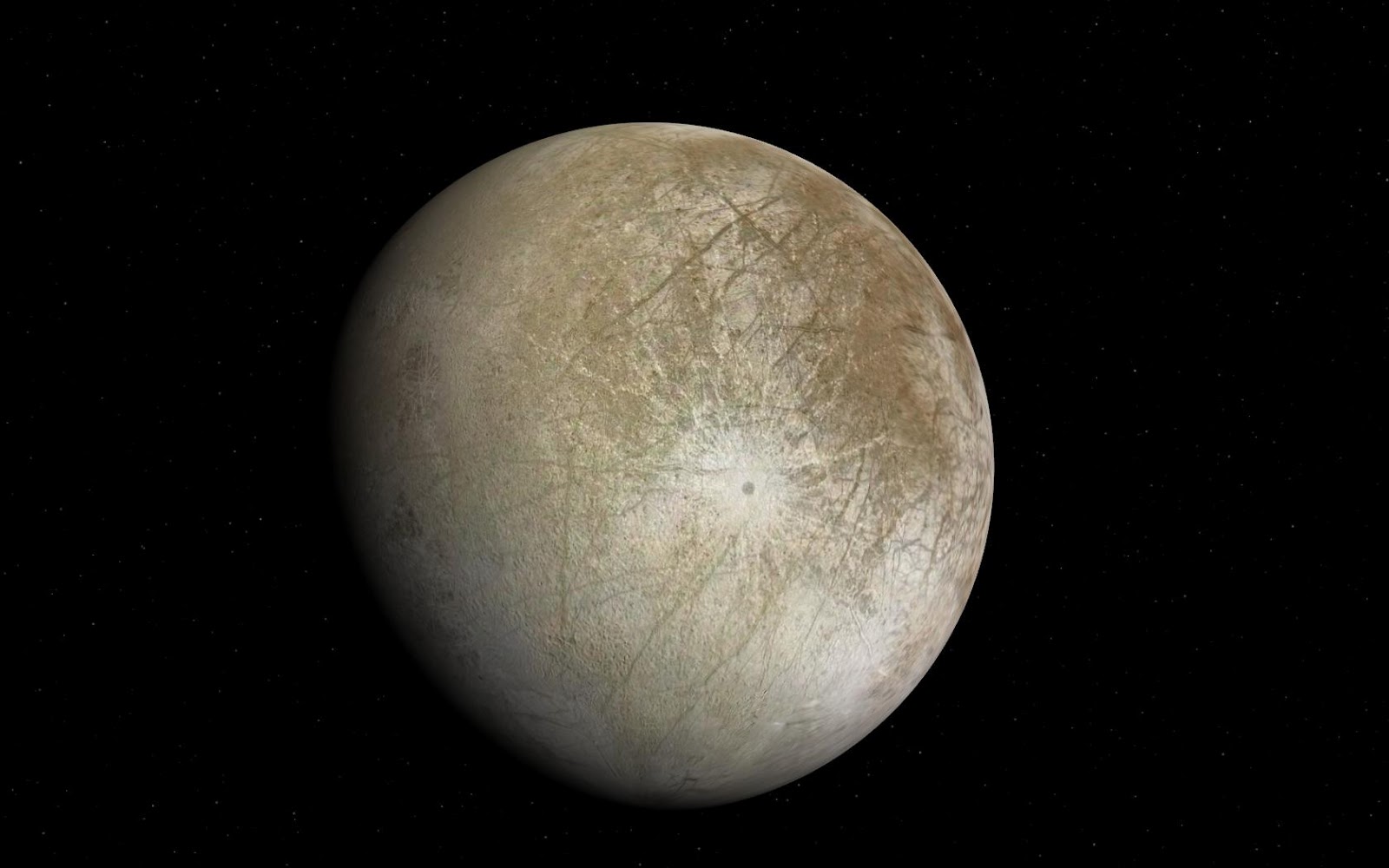
Europa

The discovery by Beatty et al. (2005) shows that photosynthesis is not just limited to the surface of the Earth and photosynthetic growth can take place using light other than sunlight. For this reason, geothermally illuminated regions such as deep-sea hydrothermal vents are particularly interesting because it opens up the possibility that photosynthesis can occur on worlds in the solar system that are located much further from the Sun than Earth. A good example is Europa, a tidally-heated moon of Jupiter with a global ocean of liquid water beneath its frozen icy surface. It is reasonable to consider the presence of photosynthetic life living off the faint amount of light emitted by hydrothermal vents at the bottom of Europa’s dark ocean.

References:
- Beatty et al. (2005), “An obligately photosynthetic bacterial anaerobe from a deep-sea hydrothermal vent”, Proceedings of the National Academy of Sciences 102 (26): 9306-10
- Cardenas et al. (2013), “The potential for photosynthesis in hydrothermal vents: a new avenue for life in the Universe?”, arXiv:1304.6127 [astro-ph.EP]