Wednesday, August 13, 2014

Occurrence of Terrestrial Planets around Cool Stars

The ever growing number of detected exoplanets shows that small planets are far more common than larger ones. A study by Morton & Swift (2014) examines the abundance of terrestrial planets with orbital periods less than 150 days around cool stars with effective temperatures below 4,000 K (i.e. red dwarf stars). These stars make up the majority of stars in the galaxy. For comparison, the Sun has an effective temperature of 5,778 K. The study analysed data from NASA’s Kepler space telescope on exoplanets in the size range between 0.5 to 4.0 Earth radii.

Figure 1: Artist’s impression of a terrestrial planet around a cool red dwarf star.

Figure 2: Distribution of planets orbiting cool stars with orbital periods less than 150 days. The blue horizontal lines represent the standard “occurrence rate per bin” calculations. The vertical red lines represent the number of planets with a particular radius is observed. Morton & Swift (2014).

Results from the study indicate there is an average of 2.00 ± 0.45 planets between 0.5 to 4.0 Earth radii per cool star. Additionally, for planets between 0.5 to 1.5 Earth radii, there is an average of one planet per cool star. The distribution of exoplanets shows a rise with decreasing planetary radius, down to one Earth radius. Below ~0.8 Earth radii, the distribution curve appears to decrease again. If the decrease is indeed a true feature, it could mean that in the formation of terrestrial planets, only a few larger planets typically remain. As a result, planets about the size of Earth could be the most likely outcome of terrestrial planet formation.

However, the drop in abundance below ~0.8 Earth radii is most likely an artefact due to inadequate data on smaller planets since these planets are more difficult to detect (Figure 3). The true distribution is expected to keep rising below 0.5 Earth radii. The distribution of exoplanets between 0.5 to 4.0 Earth radii also indicates that planets larger than ~3 Earth radii are very rare around cool stars. Finally, estimates from the study show there are ~0.25 habitable-zone Earth-sized planets per cool star, and the number could be as high as ~0.8. This suggests that habitable-zone Earth-sized planets are ubiquitous around cool stars.

Figure 3: Discovery efficiency as a function of planet radius. Morton & Swift (2014).

Reference:
Timothy D. Morton and Jonathan Swift, “The Radius Distribution of Planets around Cool Stars”, 2014 ApJ 791 10

Tuesday, August 12, 2014

Rapidly Spinning Asteroids

Asteroids range in size from a few meters to a few hundred kilometres. Observations indicate that asteroids larger than 150 m have rotation periods longer than 2.2 hours. This is because asteroids larger than 150 m tend to be rubble-pile structures bound by gravity. A rotation period shorter than the critical 2.2 hours can cause the asteroid to break apart. In contrast, smaller asteroids are generally coherent monolithic objects, allowing them to have more rapid spin rates.

Nevertheless, two asteroids, 2001 OE84 and 2005 UW163, are both known to be larger than 150 m and have spin periods shorter than 2.2 hours. 2001 OE84 has a diameter of ~700 m and a rotation period of 29 minutes (Pravec et al. 2002), while 2005 UW163 has a diameter of ~600 m and a rotation period of 1.29 hours (Chang et al. 2014). The rotation periods of both asteroids were determined by timing the photometric variations as they spin.

2001 OE84 and 2005 UW163 are rotating too rapidly to be strengthless rubble-pile aggregates. In addition to gravity, other mechanisms such as tensile strength and cohesiveness are required to keep the asteroids from breaking apart. 2001 OE84 and 2005 UW163 could be unusually large coherent monolithic objects. Discovering more of such objects can help reveal their abundance.

Plot of diameters versus rotation period. The green and gray filled circles are objects with well determined rotation periods. The asteroids 2005 UW163 (red filled circle) and 2001 OE84 (blue filled circle) are outliers. Chang et al. (2014).

References:
- Pravec et al. (2002), “Large coherent asteroid 2001 OE84”, Proceedings of Asteroids, Comets, Meteors - ACM 2002.
- Chang et al. (2014), “A New Large Super-Fast Rotator: (335433) 2005 UW163”, arXiv:1407.8264 [astro-ph.EP]

Monday, August 11, 2014

White Dwarf Shreds Planet in a Burst of X-Rays

The globular cluster NGC 6388 is believed to harbour an intermediate mass black hole (IMBH) with ~1000 times the Sun’s mass at its centre. On 11 August 2011, the INTEGRAL satellite detected a hard X-ray transient identified as IGR J17361-4441 near the centre of NGC 6388. The hard X-ray transient was thought to have originated from the IMBH at the centre of the globular cluster. However, follow-up observations reveal that the position of the hard X-ray transient was off-centre and could not possibly be related to the IMBH.

Figure 1: Artist’s impression of a planet in the dense stellar environment of a globular cluster.

A study by M. Del Santo et al. (2014) suggests that IGR J17361-4441 is consistent with a tidal disruption event (TDE). Its nature as a TDE is based on two pieces of empirical evidences. Firstly, the decline of the X-ray light curve is typical for a TDE (Figure 2). Secondly, observations of TDEs from the disruption of stars by supermassive black holes (SMBHs) show a thermal emission component that does not evolve significantly with time. Such a thermal emission was observed for IGR J17361-4441 (Figure 3).

Observational analysis and theoretical calculations indicate that IGR J17361-4441 is most likely a TDE involving a white dwarf and a disrupted planetary object. The mass of the disrupted planetary object depends on the accretion efficiency (i.e. how much of the planetary material that is accreting onto the white dwarf is converted into energy to power the hard X-ray transient). It turns out that the disrupted planetary object is estimated to have a mass that is on the order of one-third the Earth’s mass.

The TDE occurred when this free-floating planetary object came too close to the white dwarf. Nevertheless, the rate of such a TDE in a globular cluster is unknown since the densities of white dwarfs and free-floating planets in globular clusters are uncertain. It is reasonable to assume that free-floating planets are more common in globular clusters as the dense stellar environment makes it more likely for planetary systems to be perturbed by passing stars. Assuming such a TDE occurs in a given globular cluster at a rate of one every ~3,000 years and the total number of globular clusters in the Milky Way is roughly 150, then the total event rate is once per ~20 years.

Figure 2: Observed X-ray light-curve of IGR J17361-4441 fitted with a model expected from a TDE (red line). M. Del Santo et al. (2014).

Figure 3: Observed thermal emission component of IGR J17361-4441. M. Del Santo et al. (2014).

Reference:
M. Del Santo et al. (2014), “The puzzling source IGR J17361-4441 in NGC 6388: a possible planetary tidal disruption event”, arXiv:1407.5081 [astro-ph.HE]

Sunday, August 10, 2014

Swarm of Planets Circling a Supermassive Black Hole

A supermassive black hole (SMBH) with ~4 million times the Sun’s mass sits in the centre of the Milky Way. Over the decades, observations have revealed the presence of a group of stars known as the S-stars that orbit very close to the SMBH. The presently known S-stars are stars that are more massive and more luminous than the Sun. This indicates a larger population of fainter members that continue to elude detection. The S-stars zip around the SMBH with speeds of up to ~10,000 km/s. Currently, S0-102 holds the record for being the star with the shortest known orbital period around the SMBH at the galaxy’s centre. S0-102 has an orbital period of 11.5 years.


The S-stars are believed to have originated from binary star systems that are disrupted due to close passages near the SMBH. When a binary star system is disrupted, one star can get ejected from the vicinity of the SMBH, while the other star is left behind in a tight orbit around the SMBH. Since planets are ubiquitous around stars, it is reasonable to assume that these disrupted binary star systems have planets of their own, at least before they became disrupted. One study by Ginsburg, Loeb & Wegner (2012) show that such disruption events can strip planets from their host stars. These planets are either left behind on independent orbits around the SMBH or ejected away from the SMBH as hypervelocity planets. Over time, planets that are left behind can create a swarm of planets around the SMBH.

Planets can attain terrific speeds if their orbits that take them sufficiently close to the SMBH. For example, a rocky planet with an Earth-like composition passing as close as it can to the SMBH without being tidally torn apart can reach up to several percent the speed of light. A head-on collision with even a small object at such a speed would be devastating for the planet. One study by Nayakshin, Sazonov & Sunyaev (2011) suggests that given the right conditions, a fragmentation cascade could destroy a swarm of planets around a SMBH. When an asteroid collides with a planet at very high velocity, it can shatter the planet, creating more fragments that can collide with more planets and so on. Such a process of fragmentation cascade could grind a swarm of planets around a SMBH into high velocity dust.

References:
- Ginsburg, Loeb & Wegner (2012), “Hypervelocity Planets and Transits Around Hypervelocity Stars”, arXiv:1201.1446 [astro-ph.GA]
- Nayakshin, Sazonov & Sunyaev (2011), “Are SMBHs shrouded by "super-Oort" clouds of comets and asteroids?”, arXiv:1109.1217 [astro-ph.CO]

Saturday, August 9, 2014

Hypervelocity Planets

At the centre of the Milky Way sits a supermassive black hole (SMBH) with a mass of around 4 million times the mass of the Sun. A close encounter of a binary star system with the SMBH can cause one star to be ejected as a hypervelocity star (HVS) with sufficient velocity to escape the gravitational pull of the Milky Way, while the other star becomes captured into an eccentric orbit around the SMBH. This is the most likely mechanism for the production of HVSs. The existence of HVSs was first theorised in 1988 and the first HVS was discovered in 2005. Several HVSs have been discovered since. Ordinary stars in the galaxy have velocities on the order of ~100 km/s, while HVSs have velocities on the order of ~1000 km/s.

A study by Ginsburg, Loeb & Wegner (2012) investigates what happens when a binary star system hosting a planetary system gets disrupted by the SMBH at the centre of the Milky Way. In particular, the study examines the generation of hypervelocity planets (HVPs). The possible outcomes from such an interaction are - a HVS, one or more HVPs, a HVS with one or more bound planets, a star left behind in an orbit around the SMBH with one or more bound planets, a planet collides into its host star, or one or more planets left behind in independent orbits around the SMBH (Figure 2 & 3).

Figure 1: Artist’s impression of a lone planet in the outskirts of a galaxy.

Figure 2: The panel illustrates the possible outcomes after a binary star system with 4 planets is disrupted by the SMBH at the Milky Way’s centre. After binary disruption a HVS is produced with two bound planets. The second star remains in a highly eccentric orbit around the SMBH. The second star’s planets are removed, and the first planet falls into a highly eccentric orbit close to the SMBH, while the second planet is ejected into a much larger, but also highly eccentric orbit around the SMBH. Ginsburg, Loeb & Wegner (2012).

Figure 3: The panel illustrates the possible outcomes after a binary star system with 4 planets is disrupted by the SMBH at the Milky Way’s centre. After binary disruption a HVS is produced with two bound planets. The second star remains in a highly eccentric orbit around the SMBH. The second star’s planets are both ejected as HVPs. Ginsburg, Loeb & Wegner (2012).

The study draws on a few sets of simulations. One particular set of simulations involves binary star systems with two planets (i.e. one planet per star). 1000 simulation runs were performed in this set of simulations. The mass of each star is set at 3 times the Sun’s mass, comparable to the masses of the presently known HVSs. The initial separation between both stars in the binary star system is 0.2 AU, while the star-planet separation varies with uniform probability in the range 0.02 to 0.04 AU. The simulation runs show that the average HVS velocity is ~1500 km/s, while the average HVP velocity is ~3000 km/s (Figure 4). The velocities of HVPs are on average ~1.5 to 4 times the velocities of HVSs. Another set of simulation runs involving binary star systems with four planets (i.e. two planets per star) produce qualitatively similar results.

For a binary star system with two planets, the probability of producing a HVP is ~30 to 40 percent. For a binary star system with four planets, the probability increases to ~70 to 80 percent. The velocity distribution of HVPs reveals a small number of HVPs with exceptionally high velocities of ~10,000 km/s (Figure 4). These extreme outliers speed through space at a few percent the speed of light. A HVP travelling at a speed of 10,000 km/s would traverse a distance of one light year in just 30 years. An observer on such a planet can see the constellations change in a matter of years while the planet is travelling through the galaxy. As the planet speeds out of the galaxy, the Milky Way would appear as a receding disk of light. Such a planet is destined to travel through the immense intergalactic void separating galaxies and clusters of galaxies.

Figure 4: Velocity distribution of HVSs and HVPs. This sample comes from 1000 simulation runs involving a binary star system with two planets. Ginsburg, Loeb & Wegner (2012).

“These warp-speed planets would be some of the fastest objects in our galaxy. If you lived on one of them, you’d be in for a wild ride from the centre of the galaxy to the universe at large,” said astrophysicist Avi Loeb of the Harvard-Smithsonian Center for Astrophysics and co-author of the study. “Other than subatomic particles, I don’t know of anything leaving our galaxy as fast as these runaway planets,” added lead author Idan Ginsburg of Dartmouth College.

Reference:
Ginsburg, Loeb & Wegner (2012), “Hypervelocity Planets and Transits Around Hypervelocity Stars”, arXiv:1201.1446 [astro-ph.GA]

Friday, August 8, 2014

Mega-Earths and Chthonian Planets

Over the years, the search for exoplanets has shown that exoplanets vary enormously in size, mass, composition, and nearly every conceivable parameter. Many of the discoveries were surprising and unexpected. Even so, rocky planets are not known to exceed ~10 times the mass of Earth. It is believed that a more massive rocky planet would have such an enormous gravitational pull that it would accrete a gas envelope during formation and end up either as an ice giant like Neptune or a gas giant like Jupiter. All that changed when Dumusque et al. (2014) reported the discovery of the first bona fide rocky planet with a mass exceeding 10 times the mass of Earth. “We were very surprised when we realized what we had found,” says astronomer Xavier Dumusque of the Harvard-Smithsonian Center for Astrophysics, who led the data analysis and made the discovery.

 Figure 1: Artist’s impression of a large rocky planet.

Kepler-10 is a Sun-like star located 560 light years away in the constellation of Draco. It hosts two transiting planets - Kepler-10b and Kepler-10c. Both planets were detected by NASA’s Kepler space telescope and their discoveries were announced in 2011. Based on how much light from its parent star each transiting planet blocks, Kepler-10b is estimated to be 1.47 times the Earth’s diameter, while Kepler-10c is 2.35 times the Earth’s diameter. The orbital periods of Kepler-10b and Kepler-10c are 20.1 hours and 45.3 days, respectively. It is clear from the orbital periods that both planets are rather close-in to their parent star, especially Kepler-10b. The equilibrium temperature on Kepler-10b is a searing 2169 K, while the equilibrium temperature on Kepler-10c is a far cooler 584 K, albeit still a few times the boiling temperature of water.

Kepler-10b is actually the first confirmed rocky planet to be discovered outside the Solar System. With its aforementioned size and a measured mass of 3.33 ± 0.49 Earth-masses, Kepler-10b has a density of 5.8 ± 0.8 g/cm³. For comparison, the density of Earth is 5.515 g/cm³. However, the mass of the second planet, Kepler-10c, remains unknown until Dumusque et al. (2014) used the HARPS-North instrument on the Telescopio Nazionale Galileo in the Canary Islands to measure the gravitational “tugging” Kepler-10c exerts on its parent star. The mass of Kepler-10c turns out to be 17.2 ± 1.9 Earth-masses. With its size and mass known, the density of Kepler-10c is 7.1 ± 1.0 g/cm³, making it the first confirmed rocky planet with more than 10 times Earth’s mass.

Kepler-10c is clearly an outlier in the mass-radius diagram (Figure 4). Its bulk composition is dominated by rocky material (i.e. silicates) and a significant amount of water amounting to between 5 to 20 percent of the planet’s mass. Most of the water is expected to be in the form of exotic high-pressure ices. Moreover, the host star of Kepler-10c is an old star that formed 10.6 billion years ago, when the universe was only 3 billion years old. Back then, heavy elements such as the iron and silicon required to form rocky planets were less common. The discovery of Kepler-10c shows that rocky planets can readily form early in the universe’s history. This is favourable for life since Earth itself is a rocky planet.

The news release by the Harvard-Smithsonian Center for Astrophysics calls Kepler-10c a “mega-Earth”. This is because Kepler-10c is well above the upper limit of 10 Earth-masses that is commonly used for the term “super-Earth”. Besides, the term “mega-Earth” seems to have caught on pretty well. It is likely that Kepler-10c is the first bona fide example of a population of rocky planets with masses exceeding 10 times the mass of Earth. Another planet, Kepler-131b, lies around the same location on the mass-radius diagram as Kepler-10c (Figure 4). However, the mass of Kepler-131b is not known accurately enough to confirm whether it is indeed a rocky planet. Kepler-131b has a mass of 16.1 ± 3.5 Earth-masses and 2.4 ± 0.2 times the Earth’s diameter.

Figure 2: Transit light curves of Kepler-10b (left) and Kepler-10c (right) along with the best-fit models. Dumusque et al. (2014).

 Figure 3: Radial velocity curves of Kepler-10b (left) and Kepler-10c (right). The radial velocity data shows how much gravitational tugging each planet exerts on its host star and so allows the mass of each planet to be estimated. Dumusque et al. (2014).

Figure 4: Mass-radius diagram for planets smaller than 4 Earth-radii and that present a mass determination better than 30 percent. The only exception are the planets from the Kepler-11 planetary system that are shown here because they have raised the issue that there may be planets with extended envelopes of hydrogen and helium even at masses less than 5 times the Earth’s mass. Filled symbols are used when the precision on the mass is better than 20 percent, highlighting measurements where an in-depth analysis of the planet composition can be done. On the mass-radius diagram, Kepler-10c is the only high-density planet more massive than 10 Earth-masses for which the precision in mass is better than 20 percent. Dumusque et al. (2014).

Enormously massive rocky planets can also form from the remnant cores of evaporated gas giant planets. This class of planets was proposed by Hebrard et al. (2003) and are called “Chthonian” planets. A gas giant planet that is in a close-in orbit around its parent star (i.e. a hot-Jupiter) can experience sufficient heating and tidal forces that can cause its layers of hydrogen and helium to be stripped away, leaving behind a remnant rocky core. Although a gas giant planet’s rocky core generally makes up only a small fraction of the planet’s total mass, it can still be up to tens of Earth-masses, and possibly more. At such close proximity to its parent star, a Chthonian planet is most probably tidally-locked, with a permanent dayside and nightside. The planet’s dayside would be a blistering inferno and the glare from its illuminated surface would be blinding, hundreds of times brighter than desert sands at noontime on Earth. A lava ocean and possibly even pools of molten metal may be present on the hellish dayside.

Observations from NASA’s Kepler space telescope have turned up three planets that could be Chthonian planets. The three planets, Kepler-52b, Kepler-52c and Kepler-57b, have maximum masses between 30 and 100 times the mass of Earth, as determined via transit timing variations (TTVs) by Steffen et al. (2012). Nevertheless, the planets are each only around twice Earth’s diameter. If their true masses are indeed close to their estimated maximum masses, then their densities would be larger than an iron planet of the same size. These high-density planets could represent the naked cores of gas giant planets that have lost their hydrogen-helium layers. After the formation of a gas giant planet, its stupendous layers of hydrogen and helium “crushes” the central solid core under extraordinarily high pressures, compressing the solid core to higher densities. The results from a study by Mocquet at al. (2014) show that the solid core left behind following the evaporation of a gas giant planet can remain in its compressed state for billions of years.

Figure 5: Artist’s impression of a gas giant planet.

 Figure 6: Artist’s impression of a high-density solid planet.

A study by Seager et al. (2007) suggests that massive O and B stars with 5 to 120 times the mass of the Sun can have very hefty protoplanetary disks containing large amounts of heavy elements. The strong UV radiation and stellar winds from these stars can photo-evaporate the volatiles from their protoplanetary disks, leaving only the solid material behind. As a result, massive solid planets with hundreds to thousands of times Earth’s mass may be able to form around these massive stars. The gravity on the surface of such a rocky behemoth can be crushingly huge. For example, a rocky planet with an Earth-like composition but with 1000 times the Earth’s mass would be ~3 times the Earth’s diameter and would have a surface gravity ~100 times stronger than on Earth (Figure 8).

Figure 7: Artist’s impression of a rocky planet.

 Figure 8: Mass-radius relationships for solid planets. The solid lines are homogeneous planets. From top to bottom the homogeneous planets are: hydrogen (cyan solid line); a hydrogen-helium mixture with 25% helium by mass (cyan dotted line); water-ice (blue solid line); silicate (MgSiO3 perovskite; red solid line); and iron (Fe; green solid line). The non-solid lines are differentiated planets. The red dashed line is for silicate planets with 32.5% by mass iron cores and 67.5% silicate mantles (similar to Earth) and the red dotted line is for silicate planets with 70% by mass iron core and 30% silicate mantles (similar to Mercury). The blue dashed line is for water planets with 75% water-ice, a 22% silicate shell and a 3% iron core; the blue dot-dashed line is for water planets with 45% water-ice, a 48.5% silicate shell and a 6.5% iron core (similar to Ganymede); the blue dotted line is for water planets with 25% water-ice, a 52.5% silicate shell and a 22.5% iron core. The blue triangles are Solar System planets: from left to right Mars, Venus, Earth, Uranus, Neptune, Saturn, and Jupiter. The magenta squares denote the transiting exoplanets. Note that electron degeneracy pressure becomes important at high mass, causing the planet radius to become constant and even decrease for increasing mass. Seager et al. (2007).

References:
- Dumusque et al. (2014), “The Kepler-10 planetary system revisited by HARPS-N: A hot rocky world and a solid Neptune-mass planet”, arXiv:1405.7881 [astro-ph.EP]
- Hebrard et al. (2003), “Evaporation rate of hot Jupiters and formation of Chthonian planets”, arXiv:astro-ph/0312384
- Steffen et al. (2012), “Transit Timing Observations from Kepler: III. Confirmation of 4 Multiple Planet Systems by a Fourier-Domain Study of Anti-correlated Transit Timing Variations”, arXiv:1201.5412 [astro-ph.EP]
- Mocquet at al. (2014), “Very high-density planets: a possible remnant of gas giants”, Philosophical Transactions of the Royal Society A, Volume 372, No. 2014
- Seager et al. (2007), “Mass-Radius Relationships for Solid Exoplanets”, arXiv:0707.2895 [astro-ph]

Thursday, August 7, 2014

A Planetary-Mass Object Forming Like Stars Do

Substellar objects are objects that are not massive enough to support hydrogen fusion in their cores to become fully-fledged stars. The division between stars and substellar objects lies at around ~75 Jupiter-masses. Free-floating objects with ever lower masses and cooler temperatures are continuously being discovered. Some of these objects are in the regime of a few Jupiter-masses. Recently, Luhman (2014) reported the discovery of a remarkably cold and low mass object located at a distance of only 7 light years. This object, identified as WISE 0855-0714, has a temperature of 250 K and a mass of 3 to 10 Jupiter-masses. It is still an open question whether such free-floating planetary-mass objects form in the same way stars do.

Figure 1: Artist’s impression of a giant planet. A planetary-mass substellar object would in many ways be similar to giant planets like Jupiter.

Joergens et al. (2014) present new studies of a free-floating planetary-mass object known as OTS44. With an estimated age of ~2 million years, OTS44 is relatively young and is still glowing radiantly hot from heat acquired during its formation. OTS44 is estimated to have a temperature of ~1700 K and a mass of ~12 Jupiter-masses. After ~1 billion years, OTS44 is expected to cool to a temperature of ~300K, cool enough for water clouds to condense in its atmosphere.

New studies of OTS44 show it has a disk of material around it and it is also actively accreting material. The circumsubstellar disk of material around OTS44 has an estimated mass of ~10 Earth-masses. If there is sufficient solid material, one or more small rocky planets might form to create a miniature planetary system around OTS44. Based on the observed motion of hydrogen gas around OTS44, the mass accretion rate of OTS44 is estimated to be ~7.6 × 10־¹² solar-masses per year. This demonstrates that typical process (i.e. the existence of disks and accretion) associated with the formation of stars can also apply to free-floating objects down to a few Jupiter-masses, and suggests that OTS44 formed in the same way stars do (Figures 2 and 3).

Figure 2: Relative disk mass versus central mass of stars and brown dwarfs including OTS 44 (red diamond). The ratio of the disk-to-central-mass of ~0.01 typical for objects between 0.03 to several solar-masses is also valid for OTS44 which has a mass of ~0.012 solar-masses.

Figure 3: Mass accretion rate versus central mass of stars and brown dwarfs including OTS44 (red diamond). The mass accretion rate of OTS44 is consistent with a decreasing trend from stars of several solar-masses to substellar objects with ~0.01 solar-masses.

Reference:
Joergens et al. (2014), “The coolest 'stars' are free-floating planets”, arXiv:1407.7864 [astro-ph.SR]

Wednesday, August 6, 2014

Glimpse of a Very Low-Mass Binary System

When a foreground object crosses the line of sight to a background object, the gravitational field of the foreground object can bend light from the background object, resulting in an observable magnification of the background object. This astrophysical phenomenon is known as gravitational microlensing. The foreground object is referred to as the “lens” and the background object is referred to as the “source”. Gravitational microlensing does not depend on the brightness of the “lens”, and so enables the detection of faint or even dark foreground objects that happen to pass in front of luminous background sources.

Figure 1: Artist’s impression of a very low-mass binary system comprised of what could be a brown dwarf circling a low-mass star.

Figure 2: Light-curve of OGLE-2013-BLG-0102. Jung et al. (2014).

As part of the Optical Gravitational Lensing Experiment (OGLE), Jung et al. (2014) present the analysis of a gravitational microlensing event. The “lens” object, identified as OGLE-2013-BLG-0102, turns out to be a very low-mass binary system with a mass-ratio of 0.13 between the two components. The primary (i.e. the more massive component) and secondary (i.e. the less massive component) have estimated masses of 0.097 ± 0.011 and 0.013±0.002 solar-masses, respectively. This places the primary at the star/brown-dwarf boundary and the secondary at the brown-dwarf/planet boundary. It is generally accepted that the division between low-mass stars and brown dwarfs is ~0.075 solar-masses, while the division between brown dwarfs and giant planets is ~0.012 solar-masses.

The projected separation between the primary and secondary is 0.80 ± 0.04 AU, indicating OGLE-2013-BLG-0102 is a close-separation very low-mass binary system. Furthermore, OGLE-2013-BLG-0102 is estimated to lie at a distance of ~10,000 light years. At such a distance, it would not have been detectable by other means, demonstrating that gravitational microlensing is a useful technique for detecting close-separation very low-mass binary systems. OGLE-2013-BLG-0102 is located in a sparsely populated region of parameter space (Figure 3). Other close-separation very low-mass binary systems that were detected via gravitational microlensing include OGLE-2009-BLG-151L, OGLE-2011-BLG-420L and OGLE-2012-BLG-0358L.

Figure 3: Total mass versus separation (left panel) and primary versus secondary masses (right panel) for a compilation of low-mass binaries. Microlensing binaries are denoted in ‘star’ marks while those discovered by other methods are marked by ‘dots’. The ‘red star’ is OGLE-2013-BLG-0102 and the three ‘blue stars’ are the binaries OGLE-2009-BLG-151L, OGLE-2011-BLG-420L and OGLE-2012-BLG-0358L. The vertical and horizontal dashed lines represent the star/brown-dwarf and brown-dwarf/planet boundaries, respectively. Jung et al. (2014).

Reference:
Jung et al. (2014), “OGLE-2013-BLG-0102La,b: Microlensing binary with components at star/brown-dwarf and brown-dwarf/planet boundaries”, arXiv:1407.7926 [astro-ph.SR]

Tuesday, August 5, 2014

Giant Planet Formation: “Cold-Start” VS “Hot-Start”

Giant planets are thought to form in two possible ways. The first method involves accreting a solid core and once the solid core attains ~10 Earth masses, it becomes massive enough to accrete hydrogen and helium in a runaway process to form a giant planet. This mode of giant planet formation is known as “core accretion”. In the Solar System, the giant planets Jupiter and Saturn are believed to have formed via core accretion. The second mode of giant planet formation involves a protoplanetary disk becoming gravitationally unstable and collapses directly to form a giant planet. This is known as “disk instability”.

Figure 1: Artist’s impression of a giant planet. Giant planets range in mass from a fraction of Jupiter’s mass to tens of Jupiter’s mass.

In the core accretion scenario, the solid core accretes gas through an accretion disk. This process cools the gas, causing it to lose much of its initial entropy and forms a giant planet that has low initial entropy (i.e. a “cold-start”). For disk instability, the gas that collapses directly to form a giant planet retains most of it intitial entropy, resulting in high initial entropy (i.e. a “hot-start”). If the age of a giant planet is known well enough, it might be possible to distinguish a “cold-start” from a “hot-start” based on observables such as the giant planet’s entropy, radius, effective temperature and spectrum.

However, the radiating efficiency of the gas could complicate the “cold-start” / “hot-start” idea. It can cause a “cold-start” that might not be as cold or a “hot-start” that might not be as hot, leading to what could be thought of as a “warm-start”. For instance, the accreting gas in the core accretion scenario may not cool as efficiently and the giant planet formed at the end of the accretion process would have a “cold-start” that is not as cold. On the contrary, the gas in the disk instability scenario may cool more efficiently than thought, resulting in a “hot-start” that is not as hot.

A giant planet formed by disk instability is expected to have higher entropy, larger radius and higher effective temperature than if it had formed by core accretion. Basically, disk instability corresponds to a “hot-start”, while core accretion corresponds to a “cold-start”. Observable differences between “cold-start” and “hot-start” scenarios can be used to distinguish whether a giant planet formed by core accretion or disk instability. These observational differences are substantial when the giant planet is young and diminish after several tens of millions of years.

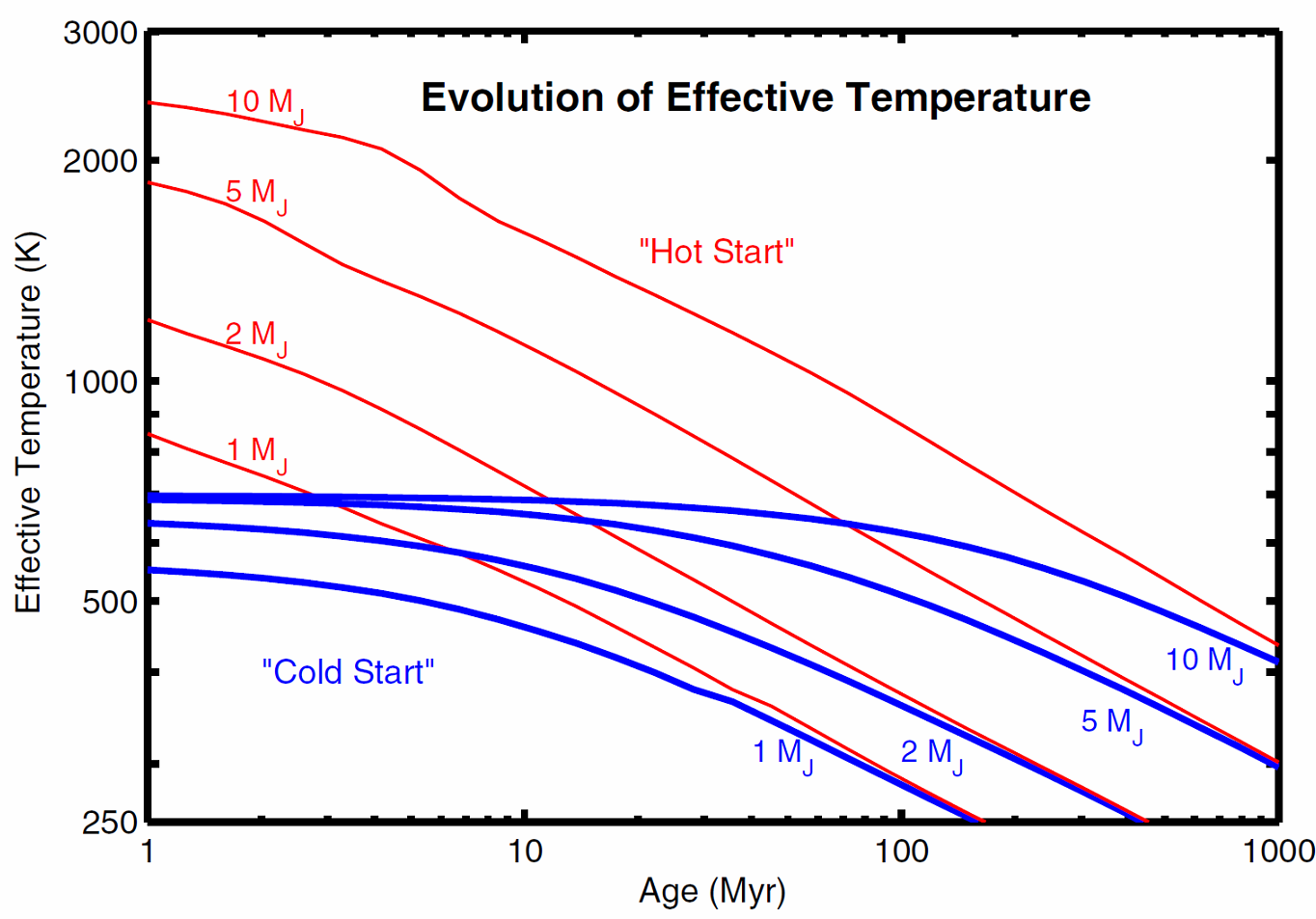
When a giant planet cools (i.e. loses entropy), its radius shrinks and its effective temperature drops. More massive giant planets retain heat longer than less massive ones, and so evolve slower. As “cold-start” and “hot-start” giant planets of equivalent masses cool over time, their entropies, radii, and effective temperatures gradually converge (Figures 2, 3 & 4). For a giant planet with 10 Jupiter masses, the “memory” of the initial conditions (i.e. whether the giant planet had a “cold-start” or “hot-start”) is lost within a few hundred million years after formation. For lower mass giant planets, the convergence is more rapid because they cool more quickly and the initial differences between “cold-start” and “hot-start” models is smaller for them.

Figure 2: Evolution of entropy for giant planets with 1, 2, 5 and 10 times Jupiter’s mass. Spiegel & Burrows (2012).

Figure 3: Evolution of radius for giant planets with 1, 2, 5 and 10 times Jupiter’s mass. Spiegel & Burrows (2012).

 Figure 4: Evolution of effective temperature for giant planets with 1, 2, 5 and 10 times Jupiter’s mass. Spiegel & Burrows (2012).

At early times, the difference between “cold-start” and “hot-start” models can be quite large. For a giant planet with ~5 times Jupiter’s mass, the differences can persist for ~100 million years. For lower mass giant planets with ~1 to 2 times Jupiter’s mass, the differences fade within ~10 to 30 million years. During the first few million years after formation, giant planets that started hot (i.e. “hot-start”) can be ~10 to 1,000 times more luminous than those that started cold (i.e. “cold-start”), depending on the giant planet’s mass and spectral band.

Reference:
Spiegel & Burrows, “Spectral and Photometric Diagnostics of Giant Planet Formation Scenarios”, 2012 ApJ 745 174

Monday, August 4, 2014

A Tidal Disruption Event in a Dwarf Galaxy

When a star comes too close to a massive black hole, tidal forces may overwhelm the star’s self-binding energy and rip the star apart in what is known as a tidal disruption event (TDE). Some fraction of the stellar material violently accretes onto the massive black hole, giving rise to a luminous tidal disruption flare (TDF). Most if not all galaxies are thought to harbour massive black holes at their centres. Large galaxies such as the Milky Way and Andromeda are hosts to supermassive black holes (SMBHs). Dwarf galaxies have correspondingly less mass black holes known as intermediate-mass black holes (IMBHs). IMBHs have masses that fall between ~100 to 1,000,000 solar-masses. However, IMBHs are difficult to observe as they have much weaker influence on their surroundings compared to SMBHs.

Figure 1: Massive black holes reside in the cores of most if not all galaxies. Large galaxies are host to SMBHs while dwarf galaxies are host to IMBHs.

Two studies by D. Donato et al. (2014) and W. P. Maksym et al. (2013) identified a possible tidal disruption of a star by the IMBH of a dwarf galaxy that is a member of the galaxy cluster Abell 1795. The observed X-ray flux from the TDF seems to be consistent with a TDE. Even so, the possibility that the source of the X-ray flux might be associated with a massive background galaxy or even a flare-up of a more distant active galactic nucleus (AGN) cannot be discounted. A more recent study by W. P. Maksym et al. (2014) with data obtained from 8 hours of observations of Abell 1795 using the Gemini North Observatory determined that the source of the X-ray flux is indeed from a dwarf galaxy in Abell 1795.

The dwarf galaxy is identified as WINGS J1348 and it has an extremely low mass of only ~300 million solar-masses. For comparison, the Milky Way has a mass of well over a trillion solar-masses. WINGS J1348 has a negligible star formation rate and this greatly reduces the probability that the X-ray flux came from a supernova since such events tend to occur in regions with active star formation. Given that a TDE is the most likely explanation for the observed X-ray flux, the IMBH responsible for the TED and its observed TDF is estimated to have a mass of between 20,000 to 70,000 solar-masses.

WINGS J1348 is one of the least massive galaxies known to host a massive black hole, in this case, an IMBH. Over a period of roughly 15 years, the X-ray flux from the TDF in WINGS J1348 has declined from peak luminosity by a factor of over ~10,000. More observations of such events would be necessary to constrain the rate of TDEs by IMBHs. In fact, TDFs from TDEs could be used to probe the properties of black holes in the intermediate-mass regime since such objects seem to be very difficult to study by other means.

Figure 2: Best fit curves and observational data (symbols) of the X-ray flux evolution for WINGS J1348. W. P. Maksym et al. (2013).

References:
- W. P. Maksym et al. (2014), “Deep Spectroscopy of the MV ~ -14.8 Host Galaxy of a Tidal Disruption Flare in A1795”, arXiv:1407.6737 [astro-ph.HE]
- D. Donato et al., “A Tidal Disruption Event in a nearby Galaxy Hosting an Intermediate Mass Black Hole”, 2014, ApJ, 781, 59
- W. P. Maksym et al., “A tidal flare candidate in Abell 1795”, MNRAS (November 01, 2013) Vol. 435, 1904-1927