Friday, July 24, 2015

Properties of a Newly Discovered Super-Neptune

Bakos et al. (2015) present the discovery of HATS-7b, a transiting Super-Neptune with an orbital period of 3.185 days around a K dwarf star. The host star of HATS-7b has an effective temperature of 4,990 K, 85 percent the Sun’s mass, 82 percent the Sun’s diameter and shines with 37 percent the luminosity of the Sun. Being a K dwarf star, it is somewhat cooler and less luminous than the Sun - a G dwarf star. The detection of HATS-7b was made using the HATSouth network, comprised of a number of fully automated telescopes in the Southern Hemisphere. The primary goal of the HATSouth network is to search for transiting exoplanets.

Figure 1: Artist’s impression of a Neptune-like planet.

By measuring how much HATS-7b dims its host star when it transits in front, the planet is estimated to be 0.563 times the size of Jupiter. As HATS-7b circles its host star, it also gravitationally perturbs its host star, causing its host star to wobble back and forth. The magnitude of wobbling depends on the planet’s mass. Radial velocity measurements of the host star’s wobbling motion indicate that HATS-7b has 0.120 times the mass of Jupiter, placing it in the mass regime of super-Neptunes. For comparison, the planet Neptune has 0.054 times the mass of Jupiter, or 17.147 times the mass of Earth.

Figure 2: Transit light curve of HATS-7b phase folded to the planet’s orbital period of 3.185 days. The lower panel zooms in on the transit. Bakos et al. (2015).

Figure 3: Radial velocity measurements for the host star of HATS-7b. The gravitational perturbation from HATS-7b induces radial velocity semi-amplitude of 18.4 ± 1.9 m/s on its host star. Bakos et al. (2015).

Knowing the size and mass of HATS-7b allows the planet’s bulk composition to be constrained. Interior models of HATS-7b indicate a hydrogen-helium (H2-He) mass fraction of 18 ± 4 percent if the planet has a rock-iron core and a H2-He envelope, or a H2-He mass fraction of 9 ± 4 percent if the planet has an ice core and a H2-He envelope. If HATS-7b has a rock-iron core and a hydrogen-helium envelope, the best fit models give a core mass of 31 ± 4 Earth-masses and an envelope mass of 7 ± 1.5 Earth-masses. If instead HATS-7b has a ice core and a hydrogen-helium envelope, the best fit models give a core mass of 34.5 ± 4 Earth-masses and an envelope mass of 3.5 ± 1.5 Earth-masses.

The composition of HATS-7b is broadly similar to that of Uranus and Neptune, but quite different from Jupiter and Saturn, which are both predominantly comprised of hydrogen and helium. Super-Neptunes like HATS-7b and the recently discovered HATS-8b (also by the HATSouth network) are important for understanding the transition from ice giants (i.e. Uranus and Neptune) to gas giants (i.e. Jupiter and Saturn). HATS-7b circles in a close-in orbit around its host star at a distance of only 6 million km. This is 25 times closer than Earth is from the Sun. The dayside of HATS-7b is heated to a temperature of over 1,000 K.

Figure 4: Mass-radius diagram of super-Neptunes (planets with less than 0.18 times Jupiter’s mass) and super-Earths with accurately measured masses and radii (less than 20 percent uncertainties). Colour indicates equilibrium temperature. HATS-7b is marked with a box and Neptune is marked with a blue triangle. Abbreviations are: K: Kepler, H: HAT, HS: HATSouth, C: Corot. Bakos et al. (2015).

References:
- Bakos et al. (2015), “HATS-7b: A Hot Super Neptune Transiting a Quiet K Dwarf Star”, arXiv:1507.01024 [astro-ph.EP]
- Bayliss et al. (2015), “HATS-8b: A Low-Density Transiting Super-Neptune”, arXiv:1506.01334 [astro-ph.EP]

Thursday, July 23, 2015

Properties of Oxygen Sequence Wolf-Rayet Stars

Oxygen sequence Wolf-Rayet (WO) stars are some of the rarest stars in the universe. To date, only nine WO stars are known, two of which are in binary systems. WO stars are remarkably hot, with surface temperatures ranging from 150,000 K to 210,000 K. For comparison, the Sun’s surface temperature is only 5,778 K. Core-helium burning is the process where helium in a star’s core undergoes nuclear fusion, leading to the production of oxygen and carbon. WO stars are massive stars that have passed the end of core-helium burning and have shed their outer envelopes through powerful stellar winds to reveal hotter underlying layers. Also, after a massive star exhausts the helium in its core, it naturally contracts and heats up. This is consistent with the high surface temperatures observed for WO stars.


WO stars are extremely luminous objects with hundreds of thousands of times the Sun’s luminosity. Despite their extreme luminosities, WO stars are generally smaller in size than the Sun. For example, the WO star WR102 is almost 300,000 times more luminous than the Sun, but its diameter is only 40 percent of the Sun’s. The intensely hot surfaces of WO stars are observed to be enriched with the products from core-helium burning, particularly carbon and oxygen. The helium surface mass fraction on WO stars is usually between 20 to 30 percent, but ranges from 44 percent for the least hot WO star to as low as 14 percent for the hottest known WO star. Observations have shown that the oxygen and carbon surface mass fractions can be as high as 24 and 62 percent, respectively, as in the case for the WO star WR102.

WO stars represent a very brief stage in the evolution of massive stars, predicted to be the final evolutionary stage of massive stars with initial masses between 40 to 60 times the Sun’s mass. These remarkable stars are likely to explode as type Ic supernovae in ~1,000 to 10,000 years. Type Ic supernovae are a class of stellar explosions caused by the core collapse of massive stars that have shed their outer envelopes of hydrogen and helium. As a result, type Ic supernovae do not contain hydrogen and helium. For comparison, type Ib supernovae are another class of stellar explosions involving massive stars that have only shed their outer envelope of hydrogen.

Locations of several WO stars on the Hertzsprung-Russell diagram. Also indicated are several WC stars (i.e. carbon sequence Wolf-Rayet stars). Tramper et al. (2015).

Model showing the evolution of the surface mass fractions of the WO star WR102 since the onset of core-helium burning. Tramper et al. (2015).

Reference:
Tramper et al. (2015), “Massive stars on the verge of exploding: the properties of oxygen sequence Wolf-Rayet stars”, arXiv:1507.00839 [astro-ph.SR]

Wednesday, July 22, 2015

A Saturn-Mass Planet beyond the Snowline of an M Dwarf Star


Gravitational microlensing is a powerful technique for detecting exoplanets that orbit their host stars beyond the snowline (i.e. the distance from a star where temperatures are cool enough for water-ice and other volatiles to condense). Beyond the snowline, a protoplanetary disk around a star is expected to contain more material, allowing for the formation of more massive planets. When a foreground star crosses the line-of-sight to a background star, the gravity of the foreground star can act as a lens, magnifying the light from the background star. The change in the brightness of the background star with time is measured in the form of a light curve. If the background star hosts a planet, the planet’s own gravity can induce a “spike” in the light curve of the background star.

Using the technique of gravitational microlensing, Fukui et al. (2015) present the discovery of a Saturn-mass planet with ~0.34 times the mass of Jupiter orbiting an M dwarf star with ~0.39 times the Sun’s mass at a projected separation of either ~0.74 AU (close model) or ~4.3 AU (wide model). The planet is identified as OGLE-2012-BLG-0563Lb and it is the 5th sub-Jupiter-mass (i.e. between 0.2 to 1.0 times the mass of Jupiter) to be found around an M dwarf star through gravitational microlensing. Although it is clear that there is a population of sub-Jupiter-mass planets around M dwarf stars, there appears to be a paucity of Jupiter-mass planets (i.e. planets with ~1 to 2 times the mass of Jupiter) around the same type of star. This suggests that planet formation via the core-accretion mechanism rarely produces Jupiter-mass planets around M dwarf stars due to the lack of material in the protoplanetary disk.

Reference:
Fukui et al. (2015), “OGLE-2012-BLG-0563Lb: a Saturn-mass Planet around an M Dwarf with the Mass Constrained by Subaru AO imaging”, arXiv:1506.08850 [astro-ph.EP

Tuesday, July 21, 2015

Two Record-Breaking Compact Stellar Systems

Following the discovery of the densest known galaxy, M60-UCD1, Sandoval et al. (2015) present the discovery of M59-UCD3 and M85-HCC1 - two record-breaking compact stellar systems. Since the density of stars in a galaxy decreases gradually away from the center, one way to express the size of a galaxy is by its half-light radius. The half-light radius is basically the size of the volume of space that is contributing to half the galaxy’s brightness and it can also apply to other stellar systems.

M59-UCD3 is an ultracompact dwarf (UCD) galaxy similar in size to M60-UCD1. It has a half-light radius of roughly 70 light years, but it is 40 percent more luminous than M60-UCD1. This makes M59-UCD3 the new densest known galaxy. M59-UCD3 is estimated to contain roughly ~180 million times the Sun’s mass and this means an average density of roughly 30 solar masses per volume of space one light year across. For comparison, an observer on Earth can see ~6,000 stars with unaided eyes under “typical” dark sky conditions. However, an observer in the core of M59-UCD3 would see roughly a million stars in the sky.


M85-HCC1 is an extremely compact stellar system with a half-light radius of roughly 6 light years, similar in size to a typical globular cluster. It is estimated to contain ~12 million times the Sun’s mass and has an average density of roughly 3,000 solar masses per volume of space one light year across. This is ~100 times the density of M59-UCD3. For comparison, the nearest star to the Sun is Proxima Centauri, located 4.24 light years away.

M59-UCD3 and M85-HCC1 are estimated to be ~9 billion and ~3 billion years old, respectively. They are most likely the remnant cores of what were once much larger galaxies that got tidally-stripped. This scenario can be tested for M59-UCD3 by looking to see if it contains an “overweight” supermassive black hole (SMBH) since almost all massive galaxies host SMBHs. M60-UCD1, the previous record holder for the densest known galaxy, is known to host an “overweight” SMBH comprising a whopping ~15 percent of the galaxy’s total mass.

References:
- Sandoval et al. (2015), “Hiding in plain sight: record-breaking compact stellar systems in the Sloan Digital Sky Survey”, arXiv:1506.08828 [astro-ph.GA]
- Strader et al. (2014), “The Densest Galaxy”, arXiv:1307.7707 [astro-ph.CO]
- Seth et al. (2014), “A Supermassive Black Hole in an Ultracompact Dwarf Galaxy”, arXiv:1409.4769 [astro-ph.GA]

Monday, July 20, 2015

Properties of a Pair of Juvenile Brown Dwarfs


Observations of DE0823-49 indicated that it is a system composed of a pair of brown dwarfs identified as DE0823-49A (primary) and DE0823-49B (secondary) with spectral types L1.5 ± 0.6 and L5.5 ± 1.1, respectively. Both objects orbit each other every ~248 days. The estimated effective temperatures of DE0823-49A and DE0823-49B are 2,150 ± 100 K and 1,670 ± 140 K, respectively. Models predict that both objects have masses between 0.028 to 0.063 times the Sun’s mass for DE0823-49A and between 0.018 to 0.045 times the Sun’s mass for DE0823-49B, with a mass ratio (i.e. mass of DE0823-49A relative to DE0823-49B) of 0.64 to 0.74. This places both objects in the brown dwarf mass regime and also below the lithium-burning mass limit of 0.065 times the Sun’s mass.

The age DE0823-49 is estimated to be between 80 million to 500 million years. This is consistant with the presence of lithium detected on DE0823-49A which implies it has a mass of less than 0.065 times the Sun’s mass. An object more massive that that is expected to burn away its lithium. Given that DE0823-49A is less than 0.065 times the Sun’s mass and still relatively hot, and that brown dwarfs cool gradually as they age, the age of DE0823-49A cannot exceed 500 million years. Since both DE0823-49A and DE0823-49B formed together, they should have the same age. With an age of less than 500 million years, DE0823-49 is a pair of juvenile brown dwarfs. It is also relatively nearby, located only 67.5 light years away.

Reference:
Sahlmann et al. (2015), “DE0823-49 is a juvenile binary brown dwarf at 20.7 pc”, arXiv:1505.07972 [astro-ph.SR]

Sunday, July 19, 2015

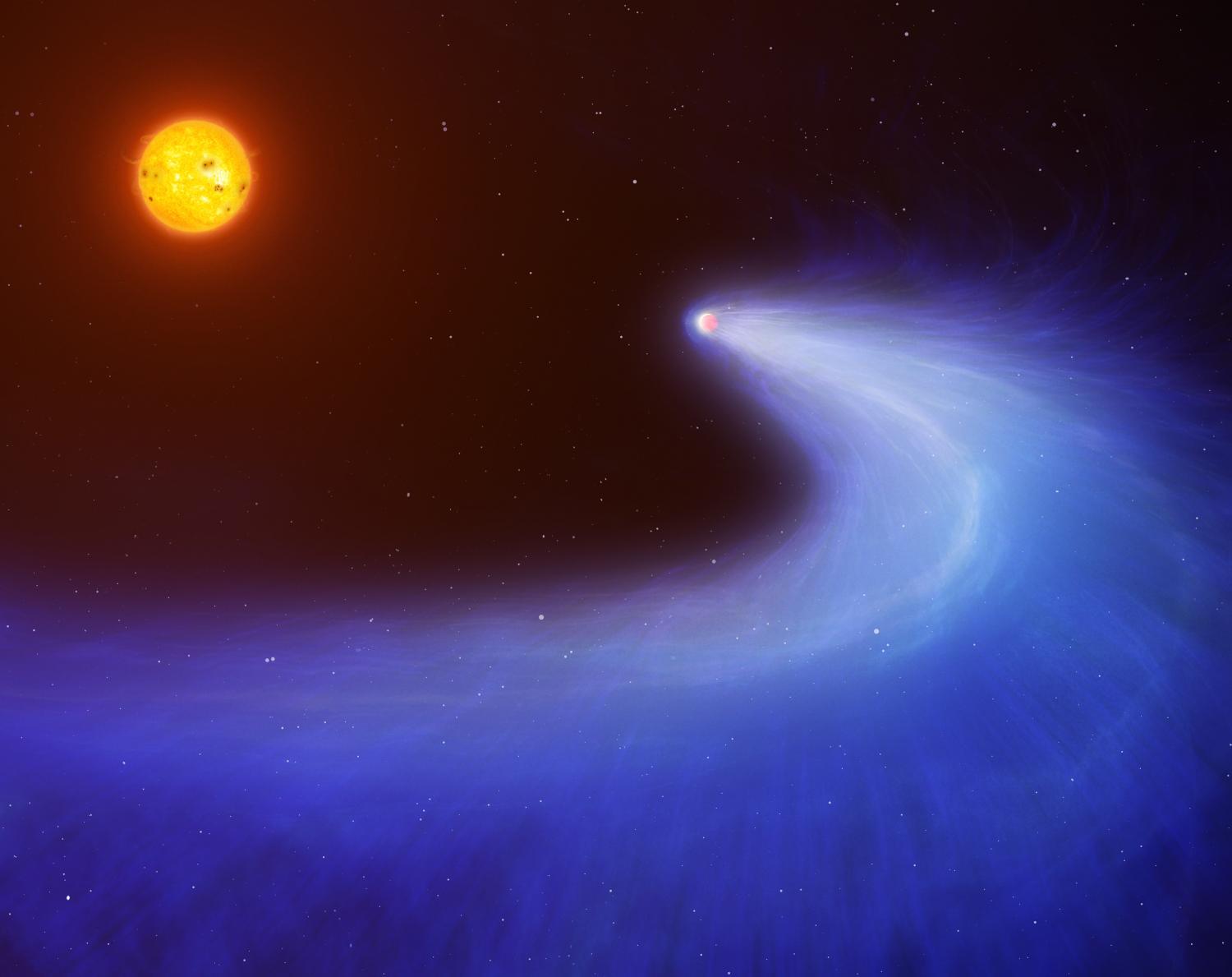
Hot-Neptune GJ 436b has a Comet-Like Tail

GJ 436b is a Neptune-mass exoplanet in a close-in orbit around its parent star. The planet is so intensely irradiated by its parent star that its own gravity is not strong enough to hold on to the hydrogen in its atmosphere, causing the hydrogen to escape into space to form a large exospheric cloud which surrounds and trails the planet. This discovery was made in the ultraviolet band with the Space Telescope Imaging Spectrograph (STIS) on the Hubble Space Telescope (HST).

Artist’s impression of GJ 436b. Image credit: Mark Garlick/University of Warwick.

GJ 436b transits in front of its parent star every 2.64 days. The transit depth in the ultraviolet band is 56.3 ± 3.5 percent (1σ), far deeper than the transit depth of 0.69 percent in the optical band. This means that over half the disk of the star is eclipsed in the ultraviolet band. Furthermore, in the ultraviolet band, the transit of GJ 436b starts ~2 hours before and ends more than 3 hours after the ~1 hour optical transit. Such a transit signature is believed to be due to the passage of a large cloud of hydrogen surround and trailing the planet.

The mass-loss rate of GJ 436b is estimated to be between ~10² to 10³ tons per second. At this rate, the planet loses only ~0.1 percent of its atmosphere per billion years, far too small to deplete the planet’s atmosphere over the lifetime of its parent star. However, planets similar to GJ 436b that orbit closer to their host stars can experience much more dramatic mass-loss, possibly even causing them to erode down to their rocky cores.

Reference:
Ehrenreich et al., “A giant comet-like cloud of hydrogen escaping the warm Neptune-mass exoplanet GJ 436b”, Nature 522, 459-461 (25 June 2015)

Saturday, July 18, 2015

Illuminating the Dark Sides of Tidally-Locked Planets

Figure 1: Artist’s impression of a habitable planet.

Red dwarf stars are by far the most common stars in the Universe. Observations by NASA’s Kepler space telescope have shown that Earth-sized planets are ubiquitous around red dwarf stars. Red dwarf stars are much smaller and much less luminous than stars like the Sun. For a planet around a red dwarf star to receive as much insolation as Earth gets from the Sun, the planet needs to orbit much closer to the star. As a result, the planet is likely tidally-locked, with a permanent dayside hemisphere and a permanent nightside hemisphere.

If an extraterrestrial civilisation evolved from such a planet or migrated in from elsewhere, it may wish to make better use of the planet’s surface by illuminating the permanent nightside. The most obvious way is to place mirrors in space to illuminate the planet’s dark side. Either a single large mirror could be stationed at the L2 Lagrange point or a fleet of smaller mirrors could be placed into orbit around the planet (Figure 2). From a feasibility standpoint, a fleet of smaller mirrors is less technically challenging than a single large mirror at the L2 Lagrange point.

Figure 2: Schematic illustration of three methods of dark-side illumination (not to scale). Planetary grayscale bands indicate different levels in stellar illumination. In the three cross-sectional drawings, (a) shows a large circular or annular mirror stationed at the L2 Lagrange point, (b) shows multiple small mirrors in circular orbits, (c) shows multiple small mirrors in elliptical orbits designed to maximise the duty cycle of the mirrors.

Illuminating the dark side of a tidally-locked planet with a fleet of orbiting mirrors will warm up the planet’s dark side and lead to a smaller day-night temperature contrast on the planet. This will slow the transfer of heat from the dayside to the nightside, causing the dayside to warm up. However, the mirrors can obscure some of the starlight falling on the planet’s dayside and this can keep the dayside from warming up excessively.

To provide sufficient illumination, a fleet of orbiting mirrors is expected to have a total reflective surface area comparable to the cross-sectional area of the planet. As a result, if the planet were to transit its parent star, the presence of such a fleet of orbiting mirrors could be detected from the unique transit light curve. In order to model and understand such a transit light curve, the fleet of mirrors orbiting the planet can be approximated as a translucent annulus around the planet.

During the initial phases of the transit (i.e. ingress), only the mirrors block starlight, so the light curve decreases relatively gradually. When the planet itself starts to transit, the light curve begins to decrease more steeply. The light curve decreases gradually again when the planet is completely in front of the star and the remaining fleet of mirrors, approximated as a translucent annulus around the planet, blocks more starlight. Once the fleet of mirrors are completely in front of the star, the transit light curve resembles that of a larger planet. 

A fleet of orbiting mirrors basically lengthens the transit duration and deepens the transit depth. If the fleet of orbiting mirrors is designed for maximum efficiency such that all the reflected starlight is directed to illuminate the planet’s dark side, then the eclipse duration (i.e. duration where the planet passes behind the star) will be smaller than the transit duration. A fleet of orbiting mirrors around a planet, if present, could be detectable by the James Webb Space Telescope (JWST).

Figure 3: Transit light curves for a planet with 2 Earth radii orbiting an M5 red dwarf star (dashed line: planet alone), the same planet surrounded by a fleet of orbiting mirrors extending to 3 planetary radii (solid line: mirror + planet), and a planet without mirrors but large enough to produce a light curve with the same depth of transit (dotted line: large planet). Korpela, Sallmen & Greene (2015).

Figure 4: Transit light curves that result when a planet with 2 Earth radii, located in the middle of an M5 red dwarf star’s habitable zone, transits in front of the star. In all cases, the planet is surrounded by a fleet of orbiting mirrors extending to 3 planetary radii (solid), 2 planetary radii (dotted) and 10 planetary radii (dashed). Korpela, Sallmen & Greene (2015).

Reference:
Korpela, Sallmen & Greene (2015), “Modeling Indications of Technology in Planetary Transit Light Curves -- Dark-side illumination”, arXiv:1505.07399 [astro-ph.EP]

Friday, July 17, 2015

Forming Graphite-Like Carbon in the Atmosphere of GJ 436b

GJ 436b is a Neptune-sized planet that orbits around a relatively small M-dwarf star located only 33 light years away. The planet is ~10 times closer to its parent star than Mercury is to the Sun and it completes one orbit around its host star in just 2.64 days. Being so close to its parent star, the planet is referred to as a hot-Neptune and its dayside is heated to a temperature of ~800 K. GJ 436b is estimated to have 22 times the mass of Earth and 4.3 times the radius of Earth. A rocky core is predicted to exist at the center of GJ 436b. Surrounding the rocky core is a mantle of exotic high pressure water-ice. Finally, an envelope of hydrogen and helium gas forms the outermost layer of GJ 436b.


By observing the thermal emission from the dayside of GJ 436b, Stevenson et al. (2010) found that the methane (CH4) to carbon monoxide (CO) ratio in the planet’s atmosphere is at least ~10,000 times smaller than predicted. This is puzzling because in a hydrogen-dominated atmosphere at the temperatures found on GJ 436b, carbon in the atmosphere should prefer CH4 over CO. A likely reason for the lower-than-expected abundance of atmospheric CH4 is that the process of photodissociation can decompose CH4 into fragments which then react with each other or with other CH4 molecules to form C2 hydrocarbons (i.e. hydrocarbon molecules containing 2 carbon atoms). Successive reactions can lead to the formation of C3 and C4 hydrocarbons.

Using laboratory experiments to mimic the chemical processes in hydrogen-dominated atmospheres containing C3 and C4 hydrocarbons at elevated temperatures, Dangi et al. (2015) show that the surfaces of silicon grains can act as a catalyst, allowing the conversion of C3 and C4 hydrocarbons to carbonaceous refractory matter with carbon content greater than 90 percent. On GJ 436b, silicon grains can be supplied by micrometeoroids. This explains the low CH4 to CO ratio in the atmosphere of GJ 436b, whereby CH4 photochemically converts to higher order hydrocarbons such as C3 and C4 hydrocarbons. The catalytic surfaces of micrometeoroids then convert these hydrocarbons to refractory graphite-like carbon.

References:
- Stevenson et al. (2010), “Possible thermochemical disequilibrium in the atmosphere of the exoplanet GJ 436b”, arXiv:1010.4591 [astro-ph.EP]
- Dangi et al. (2015), “Toward the Formation of Carbonaceous Refractory Matter in High Temperature Hydrocarbon-rich Atmospheres of Exoplanets Upon Micrometeoroid Impact”, ApJ 805:76 (7pp)

Thursday, July 16, 2015

Saturn’s Phoebe Ring is Even Larger than Thought

Figure 1: Artist’s conception of Saturn’s giant Phoebe ring as seen in infrared light. Credit: NASA/JPL/Space Science Institute.

Saturn’s giant Phoebe ring, discovered in 2009, is believed to be formed by particles thrown off from Phoebe, a distant moon of Saturn whose surface is as dark as coal. When it was discovered, the Phoebe ring was observed to lie between 128 and 207 Saturn radii from the planet, with a vertical extent of 40 Saturn radii. A recent study published by Hamilton et al. (2015) using new observations from NASA’s Wide-field Infrared Survey Explorer (WISE) mission found that the Phoebe ring is much larger than previously measured.

WISE acquired an infrared image of the entire Phoebe ring which shows the ring spanning between 100 and 270 Saturn radii from the planet. This is well beyond the orbit of Phoebe which goes around Saturn between 180 and 270 Saturn radii from the planet. The Phoebe ring covers an area of sky ~7,000 times larger than Saturn itself. It is likely that small moons with Phoebe-like orbital inclinations that orbit Saturn more distant than Phoebe itself are additional contributors of ring material. If many of these small moons turn out to be undiscovered 100 m sized or kilometre-sized objects, then they are likely to be an important additional source of ring material.

Figure 2: Measured profile of Saturn’s giant Phoebe ring. Ring flux is clearly detectable to at least 270 Saturn radii, well beyond Phoebe’s maximum distance of 250 Saturn radii from Saturn. All ring profiles agree well inward to about 100 Saturn radii at which point scattered light from Saturn becomes problematic. Hamilton et al. (2015).

Reference:
Hamilton et al., “Small particles dominate Saturn’s Phoebe ring to surprisingly large distances”, Nature 522, 185-187 (11 June 2015)

Wednesday, July 15, 2015

Birth of a Supermassive Black Hole


The existence of supermassive black holes (SMBHs) with ~1 billion times the Sun’s mass in the early Universe is a puzzle because there is insufficient time for stellar mass black holes with ~10 times the Sun’s mass to grow into SMBHs. A study by Matsumoto et al. (2015) propose that the conditions present in the early Universe can allow protostars to quickly grow to form supermassive stars (SMSs) with ~100,000 times the Sun’s mass. When these SMSs exhaust their nuclear fuel, they collapse directly to form massive black holes with ~10,000 times the Sun’s mass. These massive black holes can seed the formation of SMBHs in the early Universe.

A SMS is expected to have a radius of roughly 1 billion kilometres and a lifespan of only ~1 million years. Once the SMS exhausts its nuclear fuel, it starts collapsing into a massive black hole. During the collapse, relativistic jets can be launched from the accretion disk around the growing, nascent black hole. The relativistic jets can break through the star’s surface to produce an ultra-long gamma ray burst (ULGRB) with duration of ~10,000 to 1,000,000 seconds. Gamma-ray bursts (GRBs) are generally classified into short gamma-ray bursts (SGRBs) with durations under 2 seconds and long gamma-ray bursts (LGRBs) with duration greater than 2 seconds. ULGRBs are a third class of GRBs with durations of ~10,000 seconds or more. The collapse of SMSs into massive black holes may be observed as ULGRBs.

Reference:
Matsumoto et al. (2015), “Direct Collapse Black Holes Can Launch Gamma-Ray Bursts and Get Fat to Supermassive Black Holes?”, arXiv:1506.05802 [astro-ph.HE]