Wednesday, April 9, 2014

Influence of Hot Jupiters on their Host Stars

A star’s magnetic activity allows it to extend its influence far beyond its surface. The Sun’s magnetic field extends billions of kilometres into space, far beyond the orbit of Pluto. Phenomena such as stellar flares and coronal mass ejections are magnetically induced processes that can profoundly influence the atmospheres of close-in exoplanets. It is well established that the magnetic activity of a star depends on its rate of rotation. A star’s rotation gradually slows as angular momentum is carried away by the stellar wind. As a result, the magnetic activity of stars like the Sun decreases over billions of years.
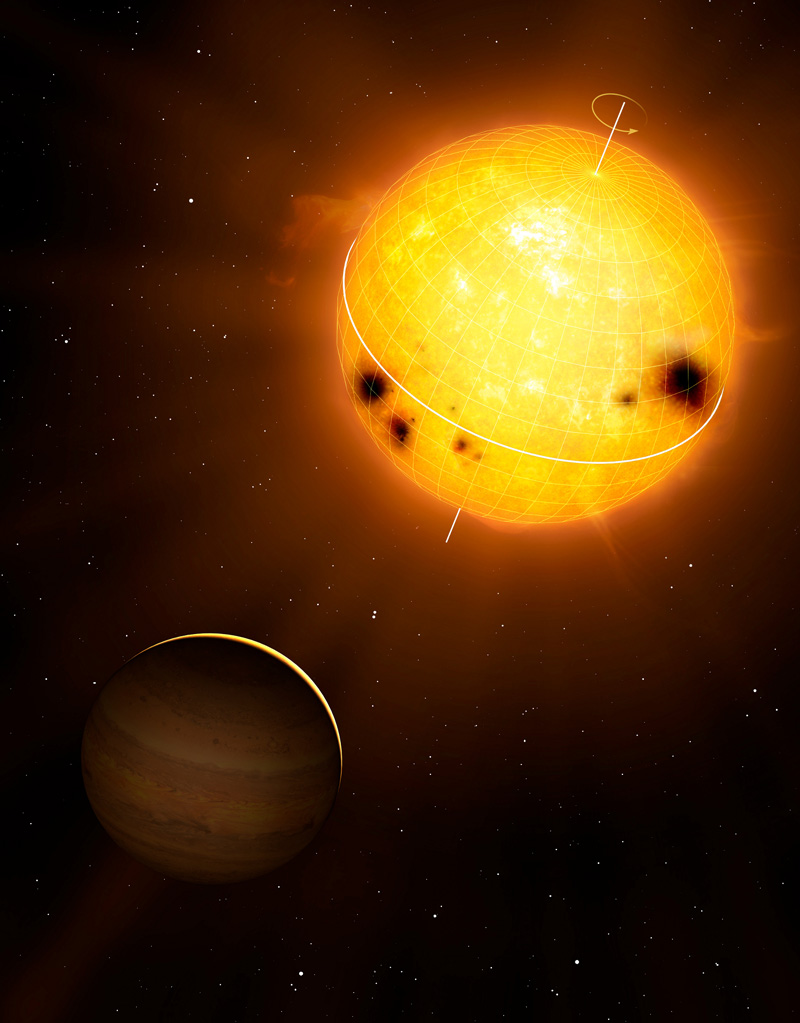

Nevertheless, stars hosting hot-Jupiters (i.e. massive planets in close-in orbits) can maintain fast rotation rates and hence high magnetic activity. In a study by K. Poppenhaeger and S.J. Wolk (2014), 5 binary star systems with widely-spaced stars (over 100 AU apart) were observed in X-rays. For each binary system, one star is known to host a close-in massive planet, while the other star does not have a detected planet and acts as a negative control. Using X-ray emission as an observational proxy for stellar magnetic activity, the stars in each binary system were observed with Chandra and XMM-Newton.

The 5 binary star systems involved in the study are HD189733 AB, CoRoT-2 AB, Tau Boötis AB, Upsilon Andromedae AB and 55 Cancri AB. For 2 of the systems - HD189733 AB and CoRoT-2 AB, where the strongest tidal interaction is expected between planet and host star, the X-ray emission of the planet-hosting star is stronger than expected when compared to the companion star. It implies that when compared to its companion star, the planet-hosting star is over-rotating.

This study shows that hot-Jupiters may inhibit the spin-down of their host stars. Two possible mechanisms can drive this process. One involves the transfer of angular momentum from the planet’s orbit to the star’s rotation through tidal interaction, spinning-up the star as a result. The second mechanism involves the hot-Jupiter opening a gap in the protoplanetary disk during the early evolution of the star, resulting in a weaker star-disk coupling and causing a smaller rate of spin-down.

Reference:
K. Poppenhaeger and S.J. Wolk (2014), “Indications for an influence of Hot Jupiters on the rotation and activity of their host stars”, arXiv:1404.1073 [astro-ph.SR]

Tuesday, April 8, 2014

Supermassive Stars around Supermassive Black Holes

Quasars are among the most energetic and luminous objects known in the universe. These objects are powered by supermassive black holes (SMBHs) accreting matter at prodigious rates in the centres of massive galaxies. SMBHs have masses ranging from ~100 million to billions of times the Sun’s mass. A quasar consists of a SMBH surrounded by a massive accretion disk. The accretion disk feeds matter to the black hole, thereby powering the quasar. A number of studies have proposed that exotic supermassive stars may form in such an accretion disk, somewhat like how planets form in protoplanetary disks around young stars.

An artist’s impression of ULAS J1120+0641, a distant quasar powered by a black hole with 2 billion times the Sun’s mass. Credit: ESO/M. Kornmesser.

Beyond a few hundred to a few thousand Schwarzschild radii from the SMBH, a quasar’s accretion disk starts to become self-gravitating. The term “Schwarzschild radius”, is a unit of measurement, where a value of one Schwarzschild radius is the distance from a black hole where the escape speed would equal the speed of light. For a SMBH with 100 million times the Sun’s mass, its Schwarzschild radius would be 300 million km.

When a quasar’s accretion disk becomes self-gravitating, it can fragment into gravitationally bound clumps and form very massive stars with masses easily exceeding a few hundred times the Sun’s mass. The term “supermassive” is truly justified here since such stars can attain masses of up to perhaps ~10,000 times the Sun’s mass, making them far more massive than the most massive stars currently known.

Once a supermassive star forms, it can clear a gap in the quasar’s accretion disk and start migrating towards the central SMBH. The migration timescale to the SMBH is comparable to the lifespan of the supermassive star. During this period, the supermassive star can interrupt the flow of gas to the SMBH and temporary dim the quasar. The final merger of the supermassive star, or what is left of it, with the SMBH could be a strong source of low frequency gravitational waves.

Detecting the presence of a supermassive star can be challenging. Although supermassive stars are very luminous, they would still be overwhelmed by the glare of the nearby quasar. Nevertheless, the presence of a supermassive star around the SMBH of a quasar can show up as a periodic milli-magnitude amplitude modulation of the quasar’s brightness, with a period ranging from a few days to a few years. The physical conditions found in a quasar’s accretion disk are much more extreme than in a conventional star-forming region. This can favour the rapid formation of truly supermassive stars.

References:
- Jeremy Goodman and Jonathan C. Tan (2004), “Supermassive Stars in Quasar Disks”, arXiv:astro-ph/0307361
- Yanfei Jiang and Jeremy Goodman (2010), “Star Formation in Quasar Disk”, arXiv:1011.3541 [astro-ph.HE]

Saturday, April 5, 2014

Enceladus’ Subsurface Ocean of Liquid Water

With a diameter of 500 km, Enceladus is a small icy moon of Saturn. Images taken by NASA’s Cassini spacecraft show large plumes of water vapour and ice erupting from the south-polar region on Enceladus. The source of these plumes, or geysers, is believed to be an ocean of liquid water beneath Enceladus’ icy crust. Tidal interactions between Enceladus and Dione (another moon of Saturn) generate the heat necessary to keep this body of water in a liquid state. A study done in 2011 found that Enceladus’ south-polar region pumps out an estimated 15.8 gigawatts of endogenic heat. This amount of heat is sufficient to maintain an ocean of liquid water under a thermally conductive icy crust.

Figure 1: Saturn’s moon Enceladus, covered in snow and ice, resembles a perfectly packed snowball in this image from Cassini. Credit: NASA/JPL-Caltech/Space Science Institute.

From 2010 to 2012, Cassini performed 3 close flybys of Enceladus that allowed for ultra-precise radio tracking of the spacecraft from Earth using the giant ground antennas of NASA’s Deep Space Network. For these close flybys, Cassini flew within 100 km of Enceladus’ surface, twice above the southern hemisphere and once over the northern hemisphere. During each flyby, the spacecraft’s velocity is perturbed by small but measurable amounts that depend on variations in the gravity field of Enceladus.

In a new study published in the April 4 issue of the journal Science, a team of researches used the Doppler data from the ultra-precise tracking measurements to map out Enceladus’ gravity field. “The way we deduce gravity variations is a concept in physics called the Doppler Effect, the same principle used with a speed-measuring radar gun,” said Sami Asmar of NASA’s Jet Propulsion Laboratory in Pasadena, California, a co-author of the paper. “As the spacecraft flies by Enceladus, its velocity is perturbed by an amount that depends on variations in the gravity field that we’re trying to measure. We see the change in velocity as a change in radio frequency, received at our ground stations here all the way across the Solar System.”

What the team found is the presence of a negative mass anomaly at Enceladus’ south-polar region. A negative mass anomaly means the area contains less mass than would be expected for a perfectly spherical body. Although a negative mass anomaly makes sense since Enceladus’ south-polar region is depressed by a depth of ~1 km, the observed negative mass anomaly turned out to the significantly smaller than expected. As a result, there must be “extra” mass beneath the surface to account for the smaller than expected negative mass anomaly.

The team’s calculations suggest that the presence of a subsurface ocean of liquid water, which is 8 percent denser than the surrounding ice, is the only reasonable explanation. In the model, the ocean is ~10 km think and lies beneath a shell of ice 30 to 40 km thick. The ocean extends from the pole to roughly 50° south latitude and its thickness diminishes toward the lower southern latitudes. Nevertheless, the current data does not rule out the possibility of a global ocean. Furthermore, the ocean is believed to be in direct contact with a rocky seafloor.

Figure 2: Enceladus’s gravity disturbances mapped onto a reference ellipsoid. The negative mass anomaly at the south-polar region is clearly indicated. Credit: L. Iess et al. (2014).

Figure 3: This diagram illustrates the possible interior of Saturn’s moon Enceladus based on a gravity investigation by NASA’s Cassini spacecraft and NASA’s Deep Space Network, reported in April 2014. The gravity measurements suggest an icy outer shell and a low density, rocky core with a regional water ocean sandwiched in between at high southern latitudes. Credit: NASA/JPL-Caltech.

This study is the first time gravity measurements were used to infer the presence of an ocean on another world. Enceladus’ subsurface ocean is probably the source of its geysers. Along with water vapour and ice, these geysers also spill out organic molecules. In the Solar System, other worlds such as Europa and Ganymede also harbour subsurface oceans of liquid water. However, Enceladus and Europa are the only ones with subsurface oceans that are in direct contact with rocky seafloors, allowing their oceans to play host to a wide range of complex chemical reactions that are conducive for life, just as in Earth's oceans. This makes Enceladus and Europa amongst the best destinations in the Solar System to search for the presence of life.

Reference:
L. Iess et al., “The Gravity Field and Interior Structure of Enceladus”, Science 344, 78 (2014)

Tuesday, February 4, 2014

Kepler-413b: A Circumbinary “Warm-Neptune”

Two years ago, the first transiting circumbinary planet, Kepler-16b, was discovered. Since then, several more circumbinary planets have been found. As the term suggests, a circumbinary planet is a planet that orbits two stars instead of one. Recently, Kostov et al. (2014) report the discovery of Kepler-413b - a Neptune-sized transiting circumbinary planet. Kepler-413b orbits a pair of stars, both of which are less massive and less luminous than the Sun. The two stars, one a spectral class K-type star and the other an M-type star, circle around each other every 10.1 days. Both stars form a K + M eclipsing binary system. Further out, Kepler-413b circles the pair every ~66 days on a somewhat eccentric orbit.

Figure 1: Artist’s impression of a possible view from the surface of a circumbinary planet. Credit: NASA/JPL-Caltech.

Kepler-413b was discovered using data from NASA’s Kepler space telescope. The Kepler light curve data for Kepler-413b show a set of 3 transits separated by ~66 days, followed by ~800 days with no transits, followed by another set of 5 transits with each transit again ~66 days apart. There is a small misalignment of ~2.5° between the orbital planet of the K + M binary and the orbital plane of Kepler-413b around the binary. As a consequence, the orbit of Kepler-413b precesses, causing long periods with no transits. In fact, the next transit is not expected to occur until 2020. Due to orbital precession from the influence of the central binary and the planet’s own eccentric orbit, Kepler-413b is likely to experience complex seasonal cycles with interesting climate patterns.

The combined incident stellar flux from the K + M binary at the orbital location of Kepler-413b varies from a minimum of ~1.64 to a maximum of ~3.86 times the average flux Earth receives from the Sun. This places Kepler-413b within the inner edge of the habitable zone around its host stars, suggesting temperatures that are probably too warm for life. Nevertheless, if a planet is a dry desert planet, it can remain habitable at even closer distances in a region known as the dry desert habitable zone. Interestingly, Kepler-413b is in this zone for most of its orbit (Figure 4) and a dry terrestrial-sized moon around Kepler-413b would be on the verge of habitability.

Figure 2: Photodynamical fits (red) to the 8 observed (and a possible 9th, labelled as “A” near time 188.35) transits. Kostov et al. (2014)

Figure 3: Orbital configuration of Kepler-413b over the course of 1/8 precession period (1/8 of ~11 years). Kostov et al. (2014)

Figure 4: Orbital location of Kepler-413b (black line) as a function of the orbital phase of the planet and equilibrium temperature, assuming a planetary Bond albedo of 0.34. The inner (red line) and outer (blue line) edges of the habitable zone are indicated, and the dashed line indicates the inner edge of the dry desert habitable zone. The planet is in the dry desert habitable zone for most of its orbit. Kostov et al. (2014)

Reference:
Kostov et al. (2014), “Kepler-413b: a slightly misaligned, Neptune-size transiting circumbinary planet”, arXiv:1401.7275 [astro-ph.EP]

Saturday, February 1, 2014

Raining Molten Iron on Luhman 16B

Brown dwarfs are substellar objects that are more massive than planets, but not massive enough to sustain hydrogen fusion and shine as full-fledged stars. These objects start out hot, and cool gradually as they age. When cooled below a temperature of ~2300 K, it is believed that silicate minerals and molten iron begin to condense to form patchy cloud systems in the atmosphere. At cooler temperatures of below ~1300 K, these clouds disappear, probably sinking into the warmer and unobservable deeper layers of the atmosphere.

Figure 1: Artist’s impression of weather on a brown dwarf. Credit: NASA/JPL-Caltech/T. Pyle (IPAC).

Using the European Southern Observatory’s Very Large Telescope (VLT) in Chile, I. Crossfield et al. (2014) have created the first ever global weather map of a brown dwarf named Luhman 16B. This object is a member of a pair of brown dwarfs known together as Luhman 16AB. As the name suggests, Luhman 16AB was discovered by Kevin Luhman, an astronomer at Pennslyvania State University in March 2013 using data from NASA’s Wide-field Infrared Survey Explorer (WISE). At a distance of just 6.5 light-years away, Luhman 16AB are not only the two closest known brown dwarfs, they are also the third nearest system - only the Alpha Centauri system and Barnard’s star are closer.

Brown dwarfs are notoriously difficult to study due to their faintness and relatively small size. However, the close proximity of Luhman 16AB puts them within easy reach of VLT’s gaze. Although both brown dwarfs were observed in the same fashion, only Luhman 16B exhibits strong temporal variability of its thermal radiation. The observed variability is consistant with Luhman 16B’s rotation period of 4.9 hours. As the brown dwarf rotates, brighter and darker areas of its surface come in and out of view to produce the observed variability. The brighter regions are believed to represent upper cloud layers that obscure the deeper and hotter parts of the atmosphere. In contrast, the brighter regions are believed to be gaps in the upper cloud layers that allow the deeper and hotter layers of the atmosphere to be seen.

Figure 2: Surface map of brown dwarf Luhman 16B. The lightest and darkest regions shown correspond to brightness variations of roughly 10%. Credit: ESO/I. Crossfield.

Luhman 16B has an estimated temperature of ~1400 K, extremely inclement by any standard. The global cloud map of Luhman 16B hints at the complexity of weather patterns on brown dwarfs. Clouds on Luhman 16B are probably comprised of iron and silicate minerals in a largely hydrogen-helium atmosphere. Here, iron can precipitate from the clouds in showers comprising droplets of molten iron. Weather on Luhman 16B can truly be exotic.

“Previous observations have inferred that brown dwarfs have mottled surfaces, but now we can start to directly map them,” said Ian Crossfield of the Max Planck Institute for Astronomy, lead author of the study. “What we see is presumably patchy cloud cover, somewhat like we see on Jupiter. In the future, we will be able to watch cloud patterns form, evolve and dissipate - eventually, maybe exo-meteorologists will be able to predict whether a visitor to Luhman 16B can expect clear or cloudy skies,” added Crossfield.

Reference:
I. Crossfield et al., “A global cloud map of the nearest known brown dwarf”, Nature 505, 654-656 (30 January 2014)

Sunday, January 19, 2014

Low Density Planets of Kepler-51

Kepler-51 is a fairly young star with an estimated age of ~300 million years and it is also slightly more luminous than the Sun. Observations of Kepler-51 by NASA’s Kepler space telescope found that it hosts three transiting planet candidates - Kepler-51 b, Kepler-51 c and KOI-620.02. The three planets have orbital periods of 45.2 days (Kepler-51 b), 85.3 days (Kepler-51 c) and 130.2 days (KOI-620.02), placing them close to a 1:2:3 resonance. By measuring the amount of light each planet blocks as it transits its host star, the size of each planet is found to be 7.1 (Kepler-51 b), 9.0 (Kepler-51 c) and 9.7 (KOI-620.02) times the Earth’s diameter.

Figure 1: Artist’s impression of a gaseous planet.

Figure 2: Phase-folded transit light curves of Kepler-51 b (top), Kepler-51 c (middle) and KOI-620.02 (bottom). Black dots are the observed fluxes and coloured solid lines show the best-fit models.

As the three planets circle their host star, they gravitationally perturb one another. This leads to transit timing variations (TTVs) where each planet transits the host star at slightly earlier or later timings, deviating somewhat from strictly periodic transit intervals. By studying the TTVs, Masuda (2014) derived the mass for each of the three planets to be 2.1 (Kepler-51 b), 4.0 (Kepler-51 c) and 7.6 (KOI-620.02) times the Earth’s mass. With the size and mass of each planet known, all three planets were found to have remarkably low densities of less than 5 percent the density of water, possibly the lowest densities yet determined for exoplanets. In comparison, the Earth has a mean bulk density of 5.52 times the density of water. With this finding, the Kepler-51 system serves as yet another example of a very low-density compact multi-transiting planetary system.

The planets around Kepler-51 have mean densities that are much lower than any of the planets in the solar system. To explain their “puffiness”, each planet probably possesses an extended outer hydrogen-helium envelop surrounding a denser core. Assuming the planetary system has an age of ~300 million years; calculations show that the observed radii of the Kepler-51 planets can be explained if they have about 10 percent (Kepler-51b), 30 percent (Kepler-51c) and 40 percent (KOI-620.02) of their masses in their hydrogen-helium envelopes. All three planets are unlikely to be habitable, at least for the type of life found on Earth, given that the planets have thick gaseous envelopes and equilibrium temperatures that exceed 100°C.

Reference:
Masuda (2014), “Very Low-Density Planets around Kepler-51 Revealed with Transit Timing Variations and an Anomaly Similar to a Planet-Planet Eclipse Event”, arXiv:1401.2885 [astro-ph.EP]

Saturday, January 18, 2014

At the Edge of Destruction

M. Gillon et al. (2014) report the discovery of WASP-103 b, an ultra-short-period planet at the edge of tidal disruption. WASP-103 b orbits an F-type star at a distance of just ~2 stellar radii from the star's surface, taking a mere 22.2 hours to complete an orbit. The WASP transit survey is sensitive to detecting ultra-short-period giant planets when these planets happen to cross in front of their host stars. WASP-103 b has 1.49 times the mass and 1.53 times the diameter of Jupiter. This newfound planet joins a small group of gas giants that are known to be at the verge of being tidally disrupted by their host stars. The group include planets such as WASP-12 b and WASP-19 b.

Artist’s impression of a gas giant. Credit: Daniel Mallia.

WASP-103 b is significantly inflated and has a bulk density that is only 55 percent the density of water. The low density of WASP-103 b is not just because of the intense irradiation it receives due to its extreme closeness to its host star. Tidal heating is also expected to contribute significantly to the planet's "bloatedness" since the planet's orbit is only 15 to 20 percent away the Roche Limit. Any closer, the planet is expected to be tidally destructed by the gravity of its host star.

Ultra-short-period gas giants that are right at the edge of being tidally disrupted might experience mass loss and significant tidal distortion. One such planet, WASP-12 b, is known to be surrounded by planetary material that has escaped it. In the case of WASP-103 b, the extreme irradiation it receives, the planet's inflated size and the brightness of its host star makes it favourable for atmospheric characterisation with existing ground-based and space-based telescopes. Observing signs of mass loss and tidal distortion for such extreme planets can shed light on the final stages in the lives of hot-Jupiters.

Reference:
M. Gillon et al. (2014), "WASP-103b: a new planet at the edge of tidal disruption", arXiv:1401.2784 [astro-ph.EP]

Thursday, January 9, 2014

Birth of a Brown Dwarf

Brown dwarfs are sub-stellar objects that are not massive enough to fuse hydrogen in their interiors and shine as full-fledged stars. Nevertheless, brown dwarfs are thought to form in the same way as stars do - from collapsing clouds of gas and dust. A study by Lee et al. (2013) of an isolated dense molecular cloud core, L328, shows that it contains three sub-cores. One of which, identified as L328-IRS, is a Very Low Luminosity Object (VeLLO) that is believed to be in the process of collapsing to form a brown dwarf.

Artist’s impression of a young brown dwarf that is in the process of accreting matter. A pair of bipolar jets can be seen stemming from it. Credit: ESO.

Observations of carbon monoxide as a tracer for the motion of matter reveal a bipolar outflow stemming from L328-IRS. By analysing the outflow, the accretion rate of the proto-brown dwarf is found to be an order of magnitude less than the accretion rate for standard star formation, consistant with the formation of a brown dwarf. Based on the accretion rate, L328-IRS is expected to grow to no more than ~0.05 solar mass. However, the accretion rate may be uncertain due to several unknown factors of the outflow itself.

Nonetheless, L328-IRS has a small total envelop mass of ~0.09 solar mass and ~100 percent star formation efficiency is also unlikely. As a result, L328-IRS is expected to be a proto-brown dwarf since it is unlikely to accrete more than ~0.08 solar mass, which is the minimum mass necessary to become a full-fledged star. The three sub-cores in L328 are though to have formed concurrently in a gravitational fragmentation process. In one of the sub-cores, global contraction of the gaseous envelop is underway to form the proto-brown dwarf L328-IRS. All these indicate that the formation of L328-IRS is consistant with the idea that brown dwarfs form like normal stars.

Reference:
Chang Won Lee et al., “Early Star-forming Processes in Dense Molecular Cloud L328; Identification of L328-IRS as a Proto-brown Dwarf”, ApJ, 777:50 (15pp), 2013 November 1

Tuesday, January 7, 2014

CoRoT-27b: A Massive and Dense Planet

Parviainen H. et al. (2014) report the discovery of a massive high-density planet on a close-in 3.58 day orbit around a 4.2 billion year old Sun-like star. The planet is identified as CoRoT-27b. Like Jupiter, CoRoT-27b is a gas-giant planet. Its presence was detected by the CoRoT space telescope as the planet periodically transits its parent star and blocks a small fraction of the star’s light. CoRoT-27b weighs in at 10.39 ± 0.55 Jupiter-masses and has 1.01 ± 0.04 times the radius of Jupiter. This gives CoRoT-27b a mean density of 12.6 times the density of water, which is more than twice the mean density of Earth and almost 10 times the mean density of Jupiter.

Figure 1: Artist’s impression of a gas-giant planet.

Like Jupiter, CoRoT-27b is a gaseous planet comprised primarily of hydrogen and helium. The structure and composition of CoRoT-27b can be inferred from two models. For the first model, the planet is assumed to be made of a central rocky core surrounded by an extensive hydrogen-helium envelop. The 1st model is consistant with a heavy element mass fraction of 0.11, representing a core mass of 366 Earth-masses. For the second model, a central rocky core is absent and the heavy elements are present throughout the hydrogen-helium envelop. The 2nd model is consistant with a heavy element mass fraction of 0.07, representing a heavy element mass of 219 Earth-masses.

CoRoT-27b falls within a sparsely populated overlapping mass regime between the most massive planets and brown dwarfs. Given its high mass, gravity on the “surface” of CoRoT-27b is 27 times the surface gravity on Earth. Technically, CoRoT-27b does not have a surface since it is gaseous through, right down to a central rocky core, if one is present. Being so near to its parent star, the equilibrium temperature on CoRoT-27b is estimated to be 1500 ± 130 K. The discovery of CoRoT-27b is an important addition to a scarcely populated class of massive close-in planets.

Figure 2: Radial velocity curve showing how much CoRoT-27b gravitationally tugs at its parent star. This information allows the planet’s mass to be estimated. Parviainen H. et al. (2014).

Figure 3: Transit light curve showing the amount of dimming of the parent star when CoRoT-27b passes in front of it. This information allows the size of the planet to be measured. Parviainen H. et al. (2014).

Figure 4: CoRoT-27b mass, period and density compared with the population of confirmed transiting exoplanets. Parviainen H. et al. (2014).

Reference:
Parviainen H. et al. (2014), “Transiting exoplanets from the CoRoT space mission XXVII. CoRoT-27b: a massive and dense planet on a short-period orbit”, arXiv:1401.1122 [astro-ph.EP]

Wednesday, December 18, 2013

A Planet on the Verge of Engulfment

Figure 1: Artist’s impression of a hot-Jupiter transiting its host star. Credit: Mark A. Garlick.

The exoplanet Kepler-91 b orbits around an evolved K3 host star that is in the process of transforming into a red giant. Observations show that Kepler-91 b is a gas-giant planet measuring 0.88 times the mass and 1.38 times the radius of Jupiter. Its host star has 1.3 times the mass and 6.3 times the radius of the Sun. Kepler-91 b circles around its host star in a slightly eccentric, close-in orbit with a period of 6.25 days. Given the planetary mass and radius, the mean density of Kepler-91 b works out to be 0.33 times the density of Jupiter. This low density suggests that Kepler-91 b is somewhat inflated due to the strong stellar irradiation from its host star.

Although the orbit of Kepler-91 b is nowhere near the shortest for exoplanets, the sheer size of its host star means that Kepler-91 b is a mere 1.32 stellar radii from the surface of its host star at closest approach. As the host star continues to expand into a red giant, estimates show that Kepler-91 b is expected to be swallowed in less than 55 million years - a mere blink of the eye on astronomical scales. Even that is considered as an upper limit to the planet’s life. The equilibrium temperature of Kepler-91 b is estimated to be over 2000 K.

Figure 2: Best-fit solutions for the transit of Kepler-91 b in front of its host star. Source: Lillo-Box et al. (2013).

 Figure 3: Diagram illustrating the irradiation of Kepler-91 b by its host star. The red lines represent the boundaries of the stellar irradiation that hits the planet’s surface. The yellow part represents the dayside of the planet. The black part represents the night side and the red part is the extra region illuminated due to the close-in orbit and the large stellar radii of the host star. Source: Lillo-Box et al. (2013).

The close-in orbit of Kepler-91 b and the sheer size of its host star result in more than half of the planet being illuminated by the host star (Figure 3). In fact, around 70 percent of the planet is illuminated by the host star. When Kepler-91 b is at closest approach, its host star would appear to subtend a remarkable 48 degrees, covering around 10 percent of the sky as seen from the planet. In comparison, the Sun covers only 0.0005 percent of the sky as seen from Earth. Kepler-91 b is indeed on the verge of being swallowed by its host star.

Reference:
Lillo-Box et al. (2013), “Kepler-91b: a giant planet at the end of its life”, arXiv:1312.3943 [astro-ph.EP]